
English


Views: 0 Author: Site Editor Publish Time: 2026-10-29 Origin: Site


A complete nail polish production line needs six equipment categories: mixing and dispersion units, milling machines, filling stations, capping equipment, labeling systems, and UV or LED curing units for gel formulas. Regular and gel polish share most of this line. The two product types diverge at light-safe handling and curing, where gel formulas demand protection from ambient light and a controlled light source to set. One facility can therefore run both products with the right configuration.
This guide serves business owners, production managers, and entrepreneurs. It supports three decisions: how to select equipment, where gel and regular polish processes differ, and how to build a complete, efficient line without bottlenecks.
One production line can make both regular and gel polish with the right equipment.
Gel polish needs special light-safe handling and a UV or LED curing unit.
Balance the speed of each stage to avoid bottlenecks and keep production smooth.
Check that equipment meets GMP, ISO, and CE standards for safety and quality.
Plan your target output, product mix, certifications, and budget before buying equipment.
A nail polish production line follows a fixed sequence from raw materials to finished bottles. Each stage builds on the last, and quality checks at every step protect the final product. The sequence stays consistent across product types.
Raw material sourcing and incoming quality inspection — film-formers such as nitrocellulose, solvents, plasticizers, pigments, and additives arrive and pass supplier qualification, material testing, and controlled storage.
Precise formulation, weighing, and mixing — automated dispensing follows the master formula; solvents and film-formers mix first, then pigments disperse under high shear and homogenize under vacuum.
Filtration and deaeration — fine mesh filtration removes undispersed particles, and vacuum deaeration removes trapped air bubbles.
Automated filling, capping, and labeling — uniform-volume filling, calibrated-torque capping, and automated labeling with batch traceability.
Stability testing and final quality assurance — accelerated aging tests check colorfastness, drying time, wear resistance, and viscosity before batch release.
This end-to-end flow moves material from mixing and high-shear dispersion through milling, filling, capping, and labeling. Each stage feeds the next, so a slow step upstream delays every step downstream. A well-designed nail polish production line balances throughput across all five stages.
Regular and gel polish share the same front-end and back-end stages. Both start with mixing, dispersion, and milling. Both end with filling, capping, and labeling. The chemistry of the film-former drives the key difference.
Regular polish is nitrocellulose-based. It hardens by solvent evaporation after application. Gel polish cures under a UV or LED lamp. This curing step is gel-specific, and it demands light-safe handling before the bottle reaches the consumer.
The shared stages let one facility serve both product types. The gel-specific stages require extra planning around light exposure and curing equipment. A line built for regular polish needs only minor additions to handle gel formulas. This flexibility keeps capital costs down and simplifies operator training.
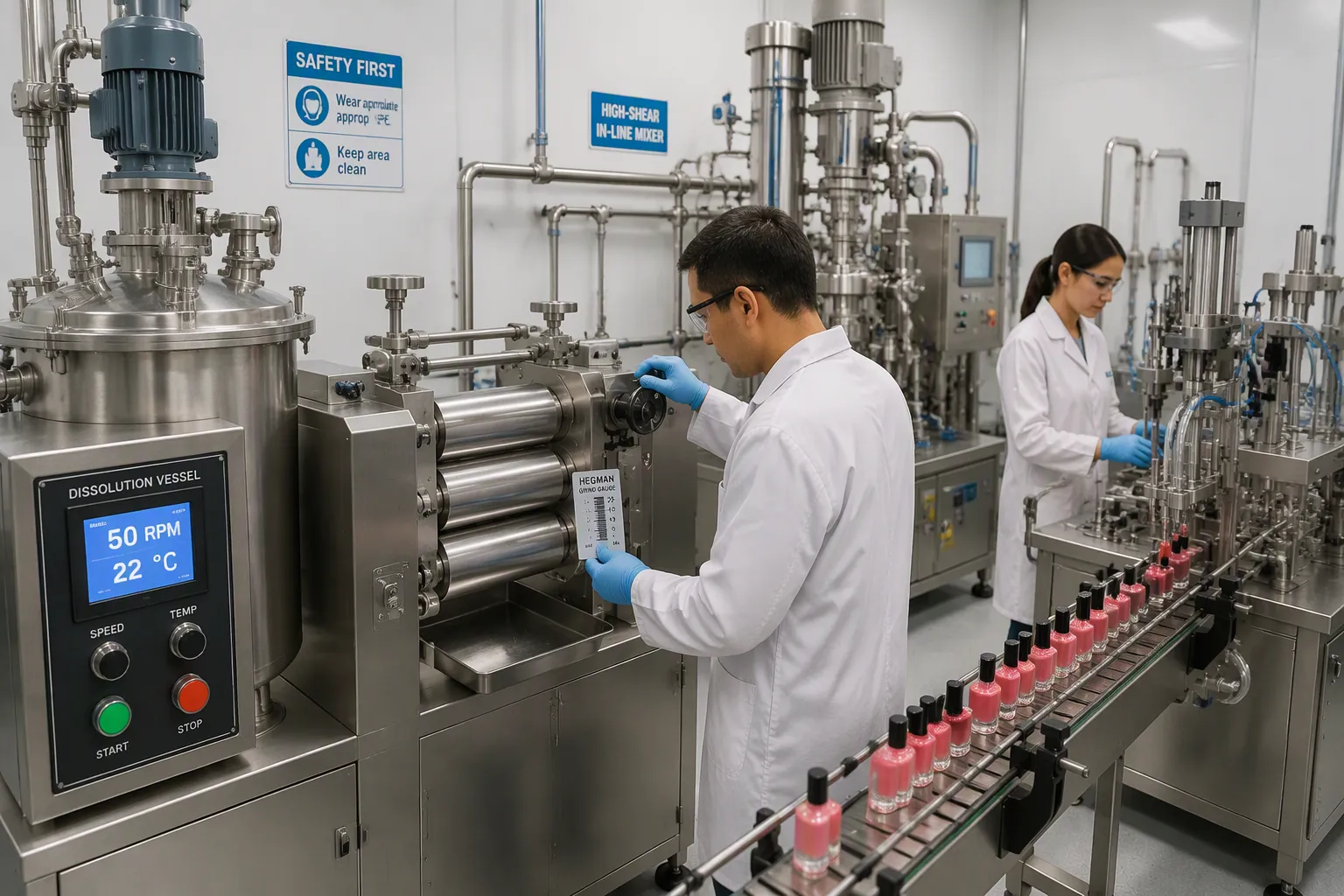
Regular polish production starts with dissolution. A stainless steel, explosion-proof dissolution vessel with nitrogen blanketing dissolves nitrocellulose into the solvent blend. Operators run the vessel at 40–60 RPM for 2–4 hours, hold temperature at 18–25°C and humidity below 60% RH, and target an output viscosity of 200–400 mPa·s at 25°C. A medium-speed in-vessel mixer then adds resins and plasticizers in sequence, with 15–30 minutes of mixing per addition.
Pigment grinding follows. A triple-roll mill runs three stainless steel rolls at differential speeds and adjusts the gap progressively across multiple passes. The target is a Hegman reading of 3–4, which corresponds to particle size below 25 μm for opaque shades and below 15 μm for clear or glitter shades. Operators verify fineness per pass with a Hegman grind gauge. A sand mill handles liquid colorants with bead sizes of 0.5–1.0 mm and pump speeds of 800–1,200 RPM.
High-shear batch mixers suit smaller batches and can mount on vessels or mobile floor stands. Sealed units support pressure or vacuum operation, and small units serve R&D and pilot runs. High-shear in-line mixers fit larger batches dedicated to one color. They are aeration free, self-pumping, and easy to retrofit, and the closed system of mixer, pipework, and vessel eliminates solvent emissions. A rotor-stator workhead draws liquid and solids inward, mills resin chips in the gap, and repeated passes progressively reduce particle size while exposing more surface area to solvent.
Final blending happens at low shear. A low-shear blender runs at 20–30 RPM for 45–60 minutes to reach a target of 80–120 KU on a Stormer viscometer at 25°C. Solvent additions of 0.5–1% follow, each with 15 minutes of mixing.
Filling speed and capping type must match the bottle design and batch size. The table below summarizes common configurations.
Machine Type | Typical Filling Speed (bottles/min) | Capping Type |
|---|---|---|
Semi-Automatic Filling Machine | 20 | Screw Cap |
Fully Automatic Filling Machine | 50 | Snap-on Cap |
Rotary Filling and Capping Machine | 80 | Screw Cap & Snap Cap |
Tabletop Capping Machine | 15 | Screw Cap |
Inline Filling and Capping System | 100 | Screw Cap |
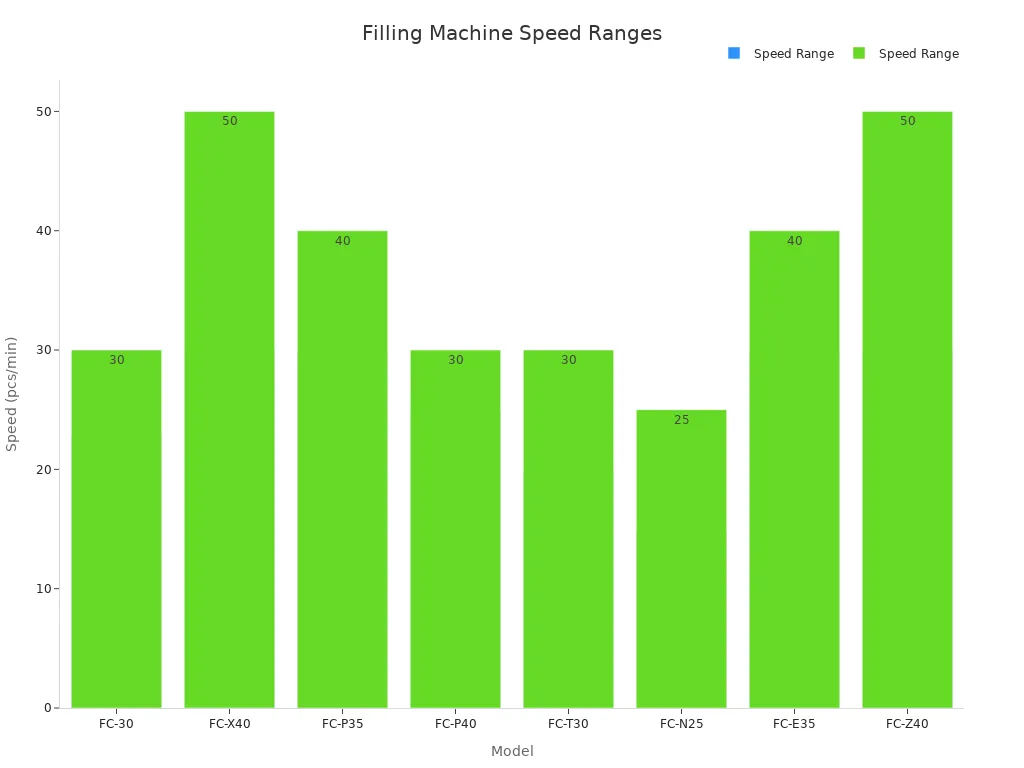
Machines generally fill and cap at 40–200 bottles per minute. Higher speeds may reduce accuracy, and a 2% fill error is a recognized source of losses. Peristaltic pump fillers such as the ZS-VTPP80C reach a filling accuracy of ≤±1% for water and run at 30–50 pcs/min depending on bottle and liquid. Capping machines like the ZS-XG16 work at 20–60 bottles/min and accept cap diameters of 18–70 mm.
Jaywin Machinery's Four-head Cosmetic paste heating, filling and freezing production line supports heated paste and liquid filling with servo-driven piston pumps for precise dosing. The Fully automatic cosmetic lip balm liquid filling production line illustrates a comparable automated filling-freezing-labeling workflow that adapts to polish-type liquids. Both units fit into a complete nail polish production line without disrupting the shared upstream stages.

Gel polish changes the handling rules. A gel formula contains photoinitiators that react to ultraviolet light. Any exposure to daylight or shop lighting can start the cure before the bottle is sealed. Premature curing thickens the mixture, shortens shelf life, and creates visible defects in the finished bottle.
Light-safe equipment solves this problem. Mixing vessels, transfer lines, and holding tanks should block UV transmission or sit inside filtered enclosures. Amber or opaque containers protect the formula during storage and transfer. Operators should work under yellow-safe lighting in the gel area, similar to the practice in photographic darkrooms. Clear glass and transparent plastic have no place in this zone.
Temperature control matters just as much. Gel formulas stay stable within a narrow thermal band. Heat accelerates unwanted reactions, and cold thickens the mixture and disturbs filling accuracy. Temperature-controlled filling keeps the formula within its safe range from the mixing tank to the nozzle. Jaywin Machinery's Fully automatic intelligent temperature-controlled lipstick filling production line shows how precise thermal control works in practice. Its integrated stirring and heating system holds raw materials at a steady temperature throughout the fill. Gel polish producers can apply the same principle to their own nail polish production line.
Curing is the stage that separates gel polish from every other cosmetic liquid. The producer must confirm the formula sets correctly under a controlled light source before release. UV and LED units both emit ultraviolet light in the 320–405 nm spectrum. The table below summarizes how the two systems compare.
System | Wavelength / Emission Spectrum | Typical Curing Time |
|---|---|---|
UV and LED (both) | Ultraviolet light in the 320–405 nm spectrum | — |
LED lamps | Discrete, narrow bell-shaped emission; peaks typically at 365, 385, or 405 nm | Cures coatings in seconds |
Traditional UV lamps | Broad-spectrum bulbs | Up to two minutes to cure a coating layer (nail gels) |
LED units cure fast and run cool, which suits high-throughput lines. Traditional UV lamps cure more slowly but cover a broader spectrum. Either choice works, provided the unit matches the photoinitiator system in the formula.
Capping follows curing verification. Gel polish needs a tight seal to block light and air during storage. Capping torque should stay consistent across every bottle, because a loose cap lets light reach the formula. Automated capping heads with calibrated torque settings protect the batch. A light-safe bottle, a verified cure, and a secure cap together complete the gel-specific stages of the line.
Filling accuracy and speed vary widely across equipment classes. Semi-automatic benchtop piston and peristaltic fillers run at 10–25 bottles per minute with ±0.1% dosing accuracy. Automatic linear multi-head systems reach 30–70 bottles per minute at ±0.05g. Monoblock rotary systems with integrated ball dropping and capping handle 60–120 bottles per minute. High-speed net weight and mass flow lines push throughput up to 150 bottles per minute using gravimetric load cells. Automatic filling machines with advanced volumetric or weight-based systems achieve precision rates exceeding 99.5%, and modern units can fill up to 120 bottles per minute.
Application fit depends on product type and batch size. Small workshops and R&D labs benefit from semi-automatic benchtop units, which offer flexibility at low volume. Mid-size producers gain from automatic linear systems that balance speed and changeover time. High-volume facilities running a full nail polish production line should consider rotary monoblock or gravimetric lines, where throughput justifies the investment. Heating and cooling control also separates options. Gel formulas need tight thermal regulation, while regular polish tolerates wider temperature bands.
Hygiene standards drive equipment selection. Nail polish production equipment must satisfy strict hygiene requirements, and high-quality machines are built from stainless steel with easy-to-clean designs to comply with GMP. The cosmetics industry is heavily regulated, so equipment should ensure safety, hygiene, and conformity with international standards such as CE, ISO, and GMP. Buyers should verify that a machine complies with international safety and cosmetic production standards before purchase. Stainless steel construction in 304 or 316 grade supports these hygiene goals.
Cost tracks complexity. Semi-automatic units carry the lowest capital outlay, while high-speed gravimetric lines cost the most. Jaywin Machinery offers customized configurations and turnkey service covering consultation, installation, training, and after-sales support. This approach lets buyers match spending to actual production needs. The Makeup lipstick, lip balm, pearlescent powder spray machine serves as an optional finishing unit for decorative effects. It adds visual appeal to lip products and works as a value-add rather than a requirement for every line.
Capacity balance decides whether a line runs smoothly or stalls at one station. Mixing, filling, and curing each have a throughput ceiling. The slowest stage sets the pace for the whole line.
Start with the filling rate, because that number is easiest to measure. Then size the mixing vessels so they feed the filler without long idle gaps. A batch that takes hours to disperse should not wait on a filler that clears bottles in minutes. Match batch size to shift length, and hold buffer stock between stages where formulas allow it.
Curing deserves separate attention on gel lines. A UV or LED unit that cures too slowly will back up the filler behind it. Add curing capacity until the tunnel clears bottles at the same rate the filler produces them. Regular polish skips this stage, so the same floor space can absorb extra filling or labeling capacity instead.
Layout follows the process flow. Raw material storage sits near mixing, milling sits between mixing and filling, and capping and labeling sit at the end. Gel areas need light-safe separation from windows and bright fixtures. Keep aisles wide enough for pallet movement and cleaning access.
Utilities must be confirmed before installation. Heating equipment typically needs 380V three-phase power, a compressed air source, and heat transfer oil where jacketed vessels are used. Jaywin Machinery's Four-head production line, for example, specifies 380V/50HZ, an air source, and 35kg of heat transfer oil. Plan drainage, ventilation, and solvent handling at the same time.
Quality checks run at every stage: incoming material inspection, dispersion fineness, fill weight, cap torque, and cure verification for gel. Jaywin Machinery acts as a turnkey partner here, offering proposal design, on-site installation, operator training, and after-sales support to complete the nail polish production line.
Most of a nail polish production line stays the same for both product types. Mixing, milling, filling, capping, and labeling serve regular and gel formulas alike. The gel-specific stages deserve the closest planning. Light-safe handling and verified curing decide whether a gel batch reaches the shelf intact.
One facility can run both products when capacity and compliance match across every stage. Before committing, readers should check four points: target output, product mix, required certifications, and budget. Jaywin Machinery designs customized layouts around those answers. Contact the team to plan a complete line.
Yes. Mixing, milling, filling, capping, and labeling serve both formulas. A facility adds light-safe enclosures and a UV or LED curing unit to cover gel. The shared stages keep capital costs down and simplify operator training across the whole nail polish production line.
Gel formulas contain photoinitiators that react to ultraviolet light. Mixing vessels, transfer lines, and holding tanks must block UV transmission. Operators work under yellow-safe lighting. Temperature-controlled filling holds the formula within its stable range. Regular polish needs none of these protections.
Start with the filling rate, since that number is easiest to measure. Then size mixing vessels to feed the filler without long idle gaps. On gel lines, add curing capacity until the tunnel clears bottles at the filler's rate. The slowest stage sets the pace.
Heating equipment typically needs 380V three-phase power, a compressed air source, and heat transfer oil where jacketed vessels are used. Jaywin Machinery's Four-head line specifies 380V/50HZ, an air source, and 35kg of heat transfer oil. Plan drainage, ventilation, and solvent handling at the same time.
Buyers should confirm compliance with GMP, ISO, and CE, and check that wetted parts use 304 or 316 stainless steel. Easy-to-clean designs support hygiene goals. Jaywin Machinery offers customized configurations and turnkey service, including proposal design, installation, training, and after-sales support.


