
English


Views: 0 Author: Site Editor Publish Time: 2026-08-06 Origin: Site


Non-Newtonian cosmetic formulations like heavy creams, lipsticks, mascaras, and concealers frequently cause severe production bottlenecks. Unstable fluid flow creates costly defects, including nozzle dripping, air entrapment, and product stringing during container transfers.
Modern engineering strategies successfully eliminate these rheological obstacles. Automated production systems now utilize multi-stage servo-driven pistons, bottom-up diving nozzles with active suck-back control, and dual-layer thermostatic hoppers to stabilize dynamic fluid behavior.
As an authoritative industry leader, Jaywin Machinery designs specialized thermal filling equipment and high-precision production lines to master High-Speed Cosmetic Filling for global cosmetics manufacturers.
Heating heavy cosmetics lowers viscosity and creates smooth fluid flow during high-speed packaging.
Servo-driven pistons deliver exact product amounts and stop unwanted air bubbles in thick creams.
Bottom-up diving nozzles start filling from container bottoms to keep creams free of air pockets.
Active suck-back nozzles prevent mess by pulling extra liquid back before drips form on edges.
Jaywin Machinery builds custom heated filling lines to boost efficiency and stop product waste.
Image Source: pexels
Cosmetic formulations exhibit complex non-Newtonian flow behavior under physical stress. Shear-thinning fluids decrease in viscosity during active movement, whereas thixotropic pastes liquefy slowly over extended agitation cycles. Rapid speed changes during High-Speed Cosmetic Filling trigger sudden variations in shear rate. These abrupt shifts create unpredictable flow resistance inside automated dosing manifolds.
Technical Note: Unstable fluid displacement directly causes operational defects inside high-output cosmetic lines.
Piston Acceleration ──> Rapid Shear Spike ──> Sudden Viscosity Drop ──> Cavitation / Dripping
Fast piston movements frequently generate internal vacuum pockets, causing liquid cavitation and air entrapment within heavy creams. Additionally, surface tension and high fluid elasticity lead to trailing and stringing when the dispensing nozzle seals. The liquid stretches instead of breaking cleanly, contaminating container edges and packaging surfaces.
Thermal energy directly alters the molecular bond strength of dense emulsions and waxes. Precision heating systems lower dynamic viscosity, converting heavy pastes into free-flowing liquids.
Product Type | Processing Temperature Range | Viscosity Reduction Effect |
|---|---|---|
Heavy Creams & Concealers | 45°C – 65°C | Stabilizes uniform flow rates |
Mascara & Lip Gloss | 70°C – 90°C | Eliminates stringing and tailing |
Anhydrous Waxes & Lipsticks | 100°C – 150°C | Enables bubble-free high-speed dosing |
Controlled heating up to 140°C–150°C stabilizes volumetric discharge rates across continuous production runs. Precise thermal zones maintain fluid fluidity without degrading delicate heat-sensitive cosmetic ingredients. Jaywin Machinery builds custom thermal channels to guarantee uniform heating across pump assemblies, preventing premature product solidification during High-Speed Cosmetic Filling cycles.
High-viscosity cosmetic formulations require advanced mechanical control during high-speed processing. Standard gravity or static filling methods fail when handling thick foundations, pastes, and heavy waxes. Specialized fluid engineering systems eliminate physical dispensing defects and maintain steady production outputs.
Bottom-up filling mechanics solve aeration issues in dense cosmetic products. Standard top-down filling drops heavy liquids from a height, trapping air pockets inside narrow jars and tubes. Diving nozzle assemblies descend directly to the bottom of empty packaging containers before dispensing begins.
Servo drives lift the nozzle tip at a rate matching the liquid volume buildup. The system keeps the nozzle orifice just beneath the rising surface of the product.
Operational Advantage: Synchronized nozzle elevation eliminates foam generation, internal air bubbles, and voids in heavy creams during High-Speed Cosmetic Filling cycles.
This controlled lifting motion maintains a uniform liquid column across every packaging container. Jaywin Machinery builds precise servo-driven lifting mechanisms that adjust elevation speeds for diverse container profiles.
Viscous pastes and cosmetic gels tend to stretch and drip between container indexing cycles. Uncontrolled dripping spoils container threads and causes costly batch contamination. Dual-action shut-off mechanisms prevent material stringing through a precise two-step sequence:
Positive Flow Cut-Off: Immediately upon completing the discharge stroke, an internal pin or valve at the tip of the positive shut-off nozzle closes to physically sever the fluid stream and stop material flow.
Negative Pressure Drawback: Simultaneously, the piston performs a micro-reverse movement (suck-back) at the end of the filling cycle, generating slight negative pressure that pulls the liquid meniscus back into the nozzle to ensure a clean break without tailing or dripping.
This mechanical combination guarantees a crisp material break after every cycle. Automated lines maintain clean container necks, reducing manual wiping requirements and product waste.
Temperature drops cause rapid viscosity spikes in heavy cosmetics. Cold hopper walls solidify molten waxes and create severe flow bottlenecks. Thermostatic material hoppers prevent solid product buildup along machine walls.
Outer Shell ──> Thermal Oil Jacket (Uniform Heat) ──> SUS316L Inner Tank ──> Product Flow
Jaywin Machinery utilizes dual-layer SUS316L stainless steel material hoppers equipped with thermal oil heating jackets. The heated thermal oil surrounds the inner vessel, transferring gentle, even heat directly into the product. Integrated electric stirring motors provide continuous agitation at variable speeds. Constant mixing keeps pigments evenly suspended and maintains homogeneous product viscosity throughout continuous operations.
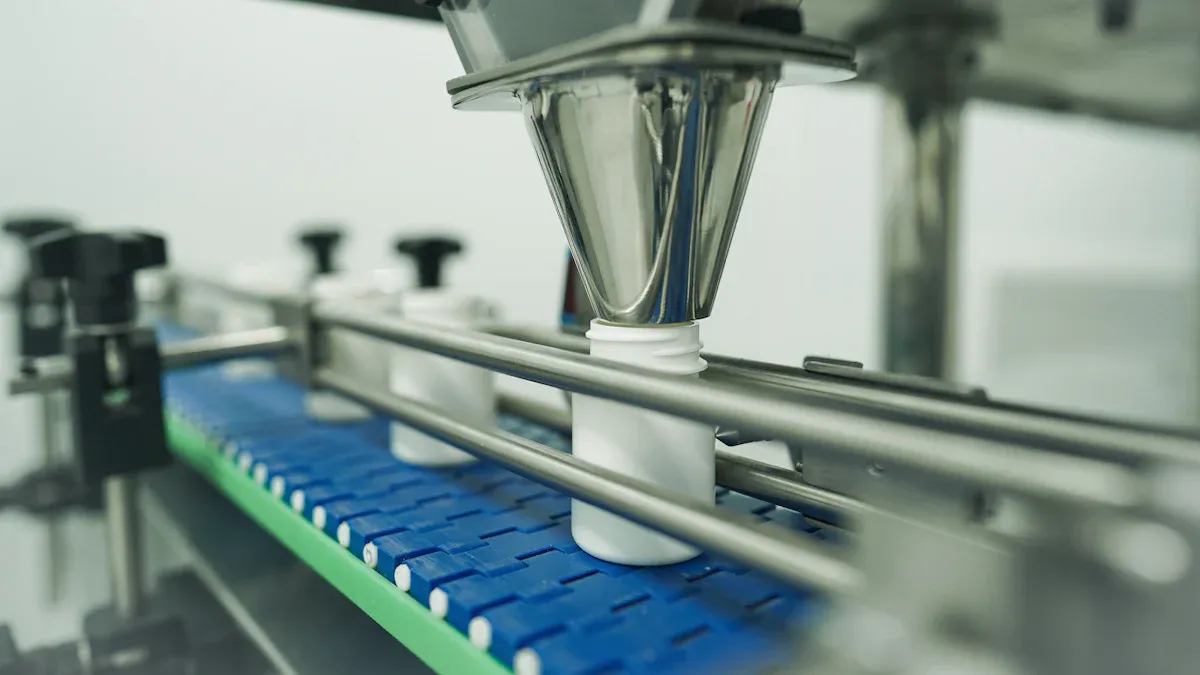
Image Source: unsplash
Automated cosmetic manufacturing lines require precise liquid measurement systems to process dense, non-Newtonian products. Standard gravity filling systems cannot handle thick pastes, emulsions, and heavy waxes. Modern cosmetic facilities rely on advanced mechanical dosing technologies to transfer viscous materials into containers quickly and accurately.
Precision filling systems utilize electronic servo motors to control piston displacement with extreme accuracy. Traditional pneumatic piston fillers rely on compressed air to drive fluid displacement. Air pressure fluctuates during daily operation. Ambient temperature changes and seal wear also degrade pneumatic accuracy over time. Conversely, servo-driven piston systems provide closed-loop control over every movement.
The electrical servo motor moves the piston rod along a pre-programmed path. Jaywin Machinery builds high-precision servo piston fillers that achieve dosing accuracy up to ±0.05g or ±0.1ml per cycle. This exceptional repeatability eliminates product give-away on automated filling lines.
Performance Metric | Programmable Servo Pistons | Standard Pneumatic Pistons |
|---|---|---|
Repeatability | Highly consistent move times and position profiles due to closed-loop control; unaffected by cycle changes or static friction. | Inconsistent; performance varies based on breakaway friction (stiction), seal condition, and environmental shifts. |
Speed & Motion Control | Fully programmable velocity and acceleration rates that follow exact pre-set time-position profiles every cycle. | Dependent on solenoid valve openings, cylinder back pressure, available air pressure, and ambient conditions. |
Electronic servo drives also simplify batch adjustments. Operators change fill volumes instantly through a touchscreen interface without manually adjusting mechanical stop blocks.
Control Parameter | Electric Servo Systems | Pneumatic Systems |
|---|---|---|
Speed & Profile Control | Precise, smooth control over velocity, acceleration, and deceleration; blends speeds seamlessly without shock impacts. | Challenging to regulate accurately; speed requires manual flow control tuning and external shock absorbers for high speeds. |
Operational Repeatability | Delivers superior, infinitely adjustable positional accuracy and consistent shift-to-shift performance. | Repeatability degrades over time due to worn seals, air leaks, pressure fluctuations, and routine wear. |
Gear pump filling mechanisms process thick foundations, liquid creams, and heavy cosmetic pastes through continuous rotary displacement. Interlocking internal gears pull viscous product into the pump housing and displace controlled liquid volumes through the outlet channel. This positive displacement method operates with very low operational noise, creating a quieter work environment for plant technicians.
High mechanical friction can degrade delicate cosmetic emulsions during active pumping. Jaywin Machinery optimizes internal gear clearances and flow channels to eliminate product stress during High-Speed Cosmetic Filling operations.
Technology / Mechanism | Design Feature | Mitigation Strategy for Shear Degradation |
|---|---|---|
Progressive Cavity Pump Design | Modified rotor/stator geometries & optimized clearances | Operates at lower rotational speeds to generate a gentler pumping motion, preserving material integrity. |
Dosing Pump Components | Smooth internal flow paths & specialized metering components | Minimizes mechanical friction and controls fluid pathways to reduce stress during dispensing. |
Material & Surface Coatings | Specialized polymers, elastomers, and smooth surface treatments | Reduces friction at fluid contact points, lowering mechanical shear during movement. |
Speed & Flow Control | Variable speed drives (VSD) & advanced control algorithms | Allows real-time optimization of velocity and pressure parameters tailored to delicate emulsion limits. |
Real-time Monitoring | Integrated sensor networks (pressure, temperature, flow) | Automatically adjusts operational settings dynamically upon detecting conditions that threaten fluid structure. |
Rotary gear pumps provide a continuous, non-pulsating fluid stream. This smooth flow profile prevents cosmetic pastes from separating or clumping inside the dispensing manifold.
Viscous cosmetics react unpredictably when piston speeds change instantly. High suction speeds cause fluid cavitation and pull air into heavy creams. Excessive discharge speeds cause product splashing and nozzle blow-back.
Technical Advantage: Programmable PLC systems resolve dynamic fluid resistance by dividing the filling stroke into distinct velocity phases.
Programmable logic controllers (PLC) manage the exact movement profile of the piston during every cycle step:
[Suction Phase: Slow Start ──> Fast Draw] ──► [Discharge Phase: Rapid Fill ──> Slow End Deceleration]
Controlled Suction Stroke: The piston starts pulling product slowly to overcome initial fluid inertia without creating internal vacuum pockets. The drive then accelerates to maximum intake speed.
Dynamic Discharge Acceleration: The piston pushes product out rapidly during the middle volume phase to maximize line speed.
Deceleration & Neck Filling: As the liquid nears the top of the container, the PLC slows the piston stroke. This speed reduction eliminates fluid splashing and surface turbulence.
Multi-stage dynamic speed profiling optimizes overall cycle times without causing air entrapment. This advanced stroke programming stabilizes heavy fluids during High-Speed Cosmetic Filling lines, ensuring high product throughput and pristine surface aesthetics.
Jaywin Machinery manufactures specialized automated equipment to solve fluid control challenges during High-Speed Cosmetic Filling operations. Advanced thermal architectures and precise drive systems maintain superior product quality across diverse cosmetic formulas.
The Servo Piston Three-Color Cosmetic Concealer Heating Filling Machine fills single, double, and three-color cosmetic pastes simultaneously. Independent digital heating zones control temperatures precisely across the material bucket, dosing pump, and dispensing nozzle. A retractable anti-drip nozzle pulls back at the stroke end to prevent material trailing. Programmable PLC systems maintain strict stroke accuracy, reducing volumetric error margins to ±0.1ml per cycle.
Heavy pastes and liquid foundations require stable volumetric movement without fluid separation. The Gear Pump Cosmetic Liquid Foundation Cream Filling Machine utilizes double-layer thermal oil jackets around the main material hopper.
Key Feature: Independent heating elements warm the pump housing and nozzle tip, preventing premature product solidification inside internal fluid channels.
The gear pump mechanism delivers smooth quantitative dispensing with extremely low operational noise. Plant technicians adjust batch parameters quickly through an intuitive touchscreen interface.
Streamlined rotary automation maximizes packaging speed for beauty liquids and thick gels. The Automatic Rotary Table Cosmetic Mascara Liquid Quantitative Filling Machine integrates filling, inner plug pressing, and cap screwing operations onto one compact rotary platform.
For high-viscosity formulations, the Lifting Double-Head Rotary Lip Gloss Filler utilizes double-layer pressurized hoppers equipped with negative pressure vacuum systems. This pressurized technology pulls micro-bubbles out of dense gels, ensuring pristine product aesthetics and drip-free seals every cycle.
Cosmetic manufacturers must align mechanical dosing designs with specific product formulations. Proper machinery selection prevents fluid dynamic failures, reduces maintenance downtime, and optimizes high-output production environments.
Production engineers select dosing mechanisms by evaluating liquid viscosity, shear sensitivity, and solid particle content. Heavy pastes with suspended glitter or exfoliants require piston displacement mechanisms. Clean liquids and uniform emulsions perform exceptionally well with continuous gear pump systems.
Decision Criterion | Piston Fillers | Gear Pump Fillers |
|---|---|---|
Target Viscosity Range | Versatile across 1,000 cP to >100,000 cP (Low, Mid, High) | Suitable for general viscous fluids requiring continuous, steady flow |
Particulate Tolerance | Capable of handling solids or chunks with rotary valve designs | Not suitable; solid particles can scratch or jam internal gear teeth |
Shear Sensitivity | Moderate shear; acceptable for standard stable formulations | Produces moderate to high shear during continuous rotary action |
Fill Accuracy & Controls | Achieves ±0.5–1% accuracy with servo drives and durable seals | Relies on continuous pulse-free displacement for clean products |
Particulate Matter Handling: Piston fillers with rotary valves process formulations containing chunks, solid glitters, or abrasive suspensions safely without jamming.
Non-Particulate Viscous Liquids: Gear pumps serve as an efficient, compact alternative for clean, particle-free gels where steady fluid pressure is necessary.
Hygienic equipment design preserves batch purity and speeds up product transitions. Modern filling machinery utilizes SUS316L stainless steel contact parts to resist chemical corrosion and prevent product adhesion.
Maintenance Advantage: Integrated Clean-in-Place (CIP) systems flush fluid channels using hot water or cleaning solvents. Automated CIP procedures eliminate manual teardowns and shorten batch changeover times to under thirty minutes.
Jaywin Machinery provides custom engineering services for global cosmetics manufacturers. The company delivers tailor-made equipment configurations, mold customization, and complete turnkey packaging line integration to ensure reliable operational performance.
Mastering viscous product lines requires dynamic servo speed profiling, precision thermal control, and anti-drip diving nozzle architectures. These advanced engineering strategies eliminate production bottlenecks and prevent material stringing. Specialized solutions from Jaywin Machinery, including heating servo piston fillers and gear pump systems, help cosmetic manufacturers minimize product waste and maximize operational throughput.
Optimize Your Production Line: Cosmetic engineers can contact Jaywin Machinery today to request fluid diagnostics, formula testing, and custom equipment proposals through the Jaywin Machinery Service Process.
Core Mechanism: Closed-loop servo motors drive fluid displacement with extreme positional accuracy.
Servo piston fillers utilize electronically controlled motor drives to manage precise fluid movement. Programmable speed profiles adjust piston intake and discharge velocity. This mechanical control eliminates air entrapment, cavitation, and volumetric errors in dense cosmetic emulsions.
Thermostatic hoppers circulate heated thermal oil through an outer jacket. This indirect thermal transfer lowers product viscosity uniformly without scorching heat-sensitive ingredients. Continuous motor agitation prevents pigment separation and maintains consistent paste fluidity throughout continuous filling operations.
Active suck-back mechanisms reverse piston movement slightly after discharge. This action generates localized negative pressure, pulling residual liquid meniscus back into the nozzle orifice. Combined with positive shut-off valves, this mechanics eliminates material stringing and keeps container threads clean.
| Technology | Primary Benefit for Foundations | | : | : | | Optimized Gear Pumps | Delivers low-shear, continuous positive displacement |
Optimized gear pumps work exceptionally well for continuous foundation dispensing. Precision internal gear clearances minimize fluid friction and mechanical stress. These positive displacement systems deliver non-pulsating, low-noise product flow without breaking delicate cosmetic emulsions during dynamic operations.


