
English


Views: 0 Author: Site Editor Publish Time: 2026-11-05 Origin: Site


Sunscreen and SPF Product Manufacturing ranks among the most equipment-sensitive categories in cosmetics. UV filters must disperse evenly, emulsions must hold stable under heat and shear, and label SPF claims must survive testing. Zinc oxide and titanium dioxide agglomerate easily. Weak pre-dispersion or insufficient shear leaves clusters that distort SPF, raise viscosity, and cause whitening or rough skin feel. High-SPF formulas also separate when shear and agitation stay uncontrolled, and open mixing traps air that later drives oxidation and filling defects. Conventional mixers rarely deliver this dispersion quality, temperature control, and batch consistency. Formulations carrying heavy active loads punish every weak point in the process. The equipment challenge starts at the very first dispersion step.
Use high-shear mixers to break down UV filter clumps for better SPF and smoother texture.
Choose vacuum emulsifiers to remove air bubbles and create stable, long-lasting sunscreen products.
Match filling equipment to your product's thickness to avoid bubbles and ensure accurate doses.
Follow OTC drug manufacturing rules to support your SPF claims and pass inspections.
Plan for thorough cleaning between batches to prevent contamination and keep quality high.
Sunscreen and SPF Product Manufacturing follows a fixed sequence of stages, and each stage sets up the next one. The process starts with powder dispersion. Operators disperse powdered ingredients such as cetyl alcohol and stearic acid into the oil phase, while a separate team prepares the water phase with emulsifiers and stabilizers. The two phases then combine into an emulsion under heat, typically between 45°C and 85°C (110°F to 185°F) depending on the formulation. UV filters enter the batch as powder, either into the water or oil phase, before or after emulsion formation. Mixing continues until the product turns homogeneous. Homogenization then refines droplet size and texture, cooling brings the batch to filling temperature, and the filling line doses the finished lotion or cream into its package.
Titanium dioxide and zinc oxide change the equipment equation. These micronized oxides arrive as clusters, and UV protection depends on breaking those clusters down to individual particle size. Conventional agitators cannot reach that level. A dedicated powder disperser achieves single-pass, lump-free dispersion and better SPF. Particle size alone does not decide performance, though. Purity, surface treatment, concentration, and interactions with other filters all shape the finished result, so formulators balance protection, dispersion, and cosmetic transparency together.
Formulators should also expect longer process times or extra equipment when they chase a fully homogeneous batch. The payoff justifies the effort. Teams can optimize intermediate stages, such as phase preparation and homogenization, to improve the manufacture of sunscreen lotions and SPF creams. Good dispersion at the front of the line protects every downstream step.
Standard mixers generate flow, not the concentrated shear that breaks powder clusters apart. A propeller or paddle agitator moves the batch around the tank, and large titanium dioxide or zinc oxide agglomerates simply travel with that flow. The impeller passes over them without applying enough force at the particle surface. Operators then extend mixing time to compensate, and the batch absorbs air, heats unevenly, and still carries visible specks.
The problem compounds during scale-up. A small trial batch may look smooth because the impeller sits close to the tank wall and the batch volume stays low. A full production batch gives the same mixer a much larger volume to turn over, and dispersion quality drops. Formulators who test only at bench scale often discover the gap after the first commercial run, when rework costs far more than a dedicated disperser would have.
Conventional tanks also struggle to hold a stable temperature profile. Heating jackets apply heat at the wall, and a slow agitator cannot distribute that heat through a viscous sunscreen base. Hot spots degrade heat-sensitive actives while cooler zones leave undissolved solids. Shear stays uneven for the same reason, so emulsion droplets vary in size across the batch.
Open mixing arrangements add a contamination risk that closed systems avoid. Common hazards in sunscreen manufacturing equipment include:
Rusty pipes coated with debris positioned directly above open mixing tanks, creating a risk of rust and debris falling into the product.
Foreign particles observed floating in a mixing tank located directly beneath one of the pipes.
Ceiling panels (aluminum sheets) partially overhanging open mixing tanks that were torn, falling, or had gaps, exposing tank contents to dirt and debris.
Bug zappers placed near filling and packaging lines, posing a potential contamination hazard.
Each of these points sits outside the formulation itself, yet any one of them can fail a batch inspection. Closed, vacuum-rated mixing equipment removes the open-tank exposure entirely.

High-shear mixers solve the dispersion problem at its source. A high-speed rotating workhead applies intense shear to the batch, and that force rapidly breaks down micronized oxide agglomerates into their smallest constituent particles. The result is a uniform, agglomerate-free dispersion within minutes, which directly improves SPF performance. Complete dispersion also fully hydrates thickening agents, maximizes yield, and delivers a stable emulsion with consistent, repeatable quality.
Conventional mixers struggle here. They disperse UV filters and thickening agents unevenly, entrain air, and often fail to reach complete emulsification, which reduces sunscreen efficacy. High-shear units shorten processing time and improve consistency, and vacuum dispersion prevents air entrapment for a uniform product.
Compared with traditional mixers, a high-shear vacuum emulsifying mixer delivers improved emulsification of UV filters and oil phases, which leads to better SPF stability and a smoother skin feel.
Homogenizers refine droplet size after emulsification, tightening texture and stabilizing the lotion before cooling. These units fit best in the dispersion and homogenization stages, where shear quality decides the batch.
Vacuum emulsifiers address air, stability, and texture together. Sealing the vessel and drawing a vacuum removes air from the mixing chamber, which prevents bubble formation and boosts the stability of the finished cream. A high-shear homogenizer disperses one phase into the other, and under vacuum the emulsification becomes more efficient, yielding fine, stable droplets. A scraper agitator continuously mixes while clearing material from the vessel wall, and residual air is eliminated under vacuum, ensuring a smooth texture and good visual quality. Removing air and creating finer droplets also improves product stability and shelf life.
The comparison favors vacuum equipment on every quality measure. Vacuum emulsifiers deliver excellent air bubble control, high emulsion stability, smooth texture uniformity, high production efficiency, and professional product appearance. Traditional mixers score poorly on air control and inconsistent on stability, texture, and appearance.
Vacuum suction feeding also helps with powders, since it avoids dust dispersal. In cream, lotion, and serum production, a vacuum emulsifying homogenizer evenly blends active ingredients, emollients, and preservatives, which prevents air-induced oxidation and supports aseptic requirements.
Bead mills take a different route. They grind pigment and oxide particles against milling media to reach a fine, narrow particle size distribution. They suit high-pigment mineral formulas and color cosmetics, while vacuum emulsifiers suit the full emulsion batch.
Filling follows emulsification. Jaywin Machinery's Cosmetic cream equipment handles this stage with servo piston and gear pump filling, heating capabilities, and multi-viscosity handling. The design suits cream and lotion filling where temperature and dose accuracy matter. For Sunscreen and SPF Product Manufacturing, the practical fit is clear: high-shear units for dispersion, vacuum emulsifiers for the emulsion, bead mills for hard-to-grind pigments, and precision fillers for the finished product.
Each equipment type earns its place at a specific point in the line. High-shear mixers and homogenizers win on dispersion speed and droplet refinement, so they fit the front of the process where oxide clusters must break down. Vacuum emulsifiers add air removal and emulsion stability, which suits the main batch vessel for lotions and creams. Bead mills reach the finest particle size distribution and fit high-pigment mineral formulas. Filling equipment closes the line, and the choice there depends on viscosity and dose accuracy.
Performance comparisons should follow the product, not the price tag. A mineral sunscreen with a heavy oxide load rewards a bead mill and a vacuum emulsifier. A chemical filter lotion may need only high-shear dispersion and a stable emulsification vessel. Matching each unit to its stage prevents overspending on capacity the formula never uses.
Machinery cost forms the largest single component of capital expenditure, and scale plus automation level drive that figure more than any other factor. Buyers can benchmark filling equipment against published ranges:
Equipment Tier | Approximate Price Range (USD) |
|---|---|
Small, semi-automatic sunscreen lotion fillers | 3,000 – 10,000 |
Mid-size automatic sunscreen lotion filling equipment | |
Industrial-scale fully automated lines (filling and capping) | 50,000 – 150,000 |
Purchase price tells only part of the story. Total cost of ownership includes routine maintenance, operator training, energy consumption, spare parts, and potential downtime. Automation level, production capacity, pump type, added features, high-viscosity handling, factory location, supplier reputation, and certifications such as CE, ISO, and GMP all shift the final figure.
Equipment must be corrosion-resistant and meet hygiene, safety, and reliability standards—an important cost factor given the formulation consistency needed in emulsification.
Compliance carries its own weight. A line built to GMP and OTC drug expectations costs more upfront, yet it protects the SPF claim on the label. Comparing several suppliers on total ownership cost, not sticker price, gives the clearest picture of value.
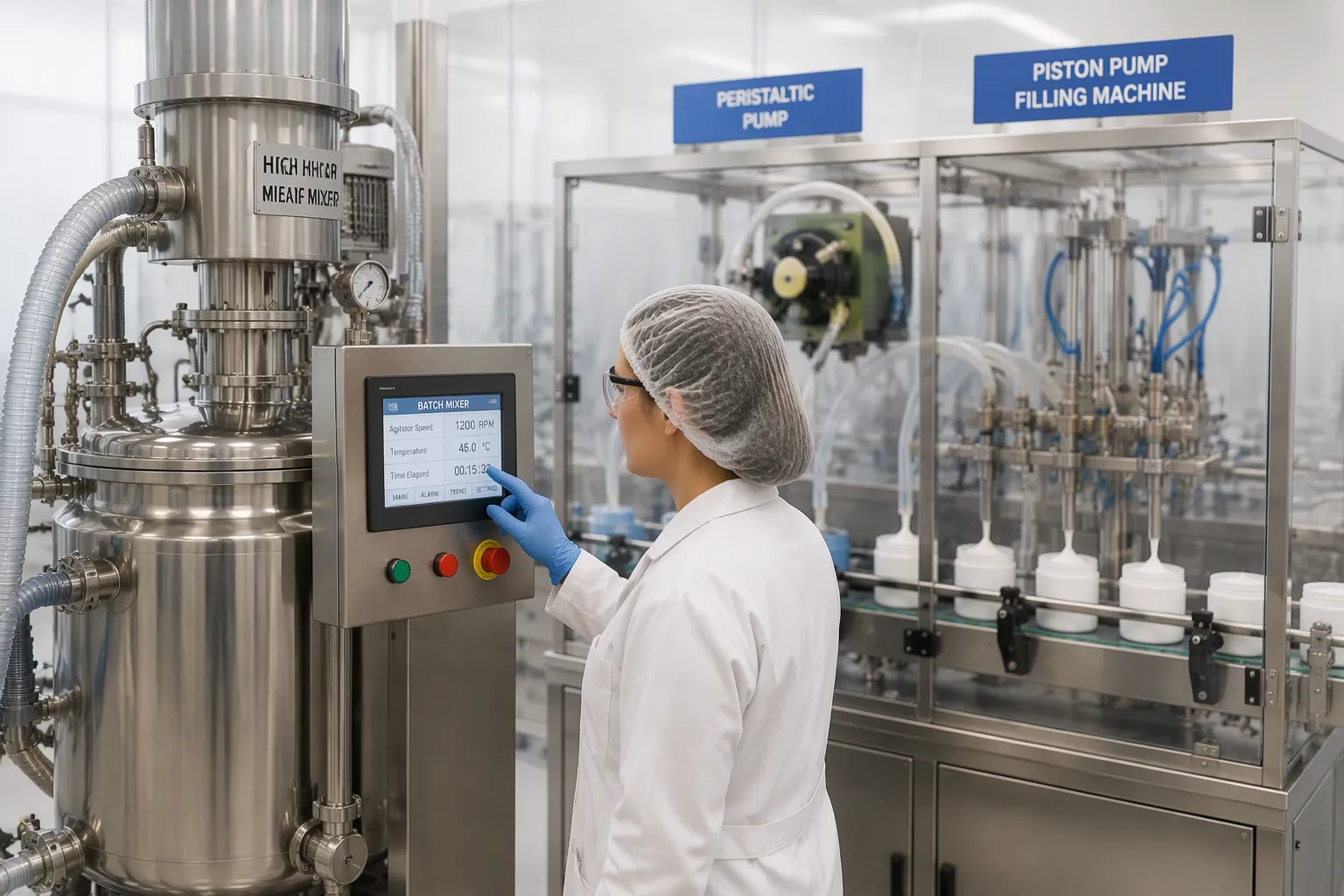
Batch size sets the first filter on the equipment list. A small laboratory works well with compact sunscreen lotion mixers in the 5–50 L range, while an industrial facility needs mixing machines that handle hundreds or thousands of liters per batch. Mixer type follows the same logic. High-shear batch mixers suit batches up to 400 US gallons and offer mobile floor stands, sealed pressure or vacuum operation, and small R&D or pilot units. High-shear in-line mixers fit larger batches, run aeration free, self-pump, retrofit into existing lines, and come in multistage and sanitary options.
Viscosity then decides the filling end of the line. Thin creams bubble when pumped too fast, medium creams demand precise dosing, and thick creams stress pumps and nozzles that were never built for high viscosity. Pump choice tracks the product: peristaltic or gear pumps for thin creams, piston pumps for medium creams, auger or heavy-duty piston pumps for thick creams. Nozzles follow suit, with narrow nozzles for thin creams to avoid splashing and wide smooth-flow nozzles for thick creams to prevent clogging. Speed matters too, since light creams fill faster and thick creams need slower, controlled filling.
A practical sequence helps teams match machine to product:
Light lotion (SPF fluid): use a servo-driven or peristaltic filling system for fast, splash-free filling.
Medium viscosity SPF products: use a piston pump lotion filling machine for accurate dosing and stable performance.
Thick sunscreen creams: use a high-viscosity lotion filling machine with heated hoppers or powerful pistons.
High-viscosity formulations trap air during pumping, so vacuum filling machines, slow controlled filling, and bottom-up nozzle positioning reduce air entrapment. Jaywin Machinery's Four-head Cosmetic paste heating, filling and freezing production line fits paste and cream products that need heating, filling, and freezing in one flow, which suits thick SPF creams and balm-type formats.
Filter type reshapes the equipment plan again. Mineral filters such as titanium dioxide and zinc oxide arrive as powders that demand dedicated dispersion and often bead milling, so the line needs high-shear capacity and dust-controlled powder handling. Chemical filters dissolve or disperse more readily, yet organic filters need photostability checks and careful temperature control during emulsification.
Cost planning deserves early attention. Sunscreen agents may only be available in large pack sizes, and they are costly. A formulator testing a small pilot batch still buys the full container, so trial budgets and minimum batch sizes must account for that waste. Large pack sizes also shape storage, weighing, and dosing equipment, since the line must handle bulk containers safely and accurately. Teams that plan Sunscreen and SPF Product Manufacturing around these constraints avoid both idle capacity and costly reformulation later.
Any product that declares an SPF on its label qualifies as a sunscreen and falls under FDA OTC drug requirements. Manufacturers must comply with the PIC/S Guide to Good Manufacturing Practice for Medicinal Products (PE009-13). The regulatory gap between a cosmetic lotion and an OTC sunscreen is wide.
Requirement | Cosmetic Lotion | OTC Sunscreen |
|---|---|---|
Active ingredients | No approved-actives list | Monograph-approved UV filters at approved concentrations |
Label | Ingredient list | Drug Facts panel plus ingredient list |
Manufacturing standard | Cosmetic GMP guidance | 21 CFR 210/211 drug manufacturing requirements |
Facility | No FDA drug registration required | |
Claims | Cosmetic claims only | SPF and broad-spectrum claims require supporting testing |
OTC drug manufacturing requirements, aerosol-specific equipment, and formulation complexity significantly narrow the field of suitable manufacturing operations. A facility must hold FDA drug establishment registration and follow 21 CFR 210/211 current good manufacturing practice, not lighter cosmetic GMP guidance. Only monograph-approved UV filters at approved concentration ranges may be used, and SPF plus broad-spectrum claims must be substantiated by testing on the finished formula.
Quality control and testing equipment are integral to Sunscreen and SPF Product Manufacturing. SPF value testing serves primarily as a UVB protection indicator. The in vivo ISO 24444:2019 method remains the gold standard: a controlled dose of 2 mg/cm² is applied to test sites, a solar simulator delivers increasing UV doses, and SPF equals the minimal erythema dose on protected skin divided by that on unprotected skin. In vitro testing on PMMA plates offers a reproducible backup for regulatory labeling.
Organic filters also require photostability checks. Formulations are exposed to artificial sunlight, and scientists measure UV absorption spectra, active ingredient concentration, SPF level, and degradation products. A product classifies as photostable when the AUCI index exceeds 0.80 at 0.5 mg/cm² application. Documentation must capture procedure, instruments, and reference standards for every batch.
Sunscreen residues cling to equipment. Titanium dioxide and zinc oxide settle into seams, pump bodies, and nozzle bores, and a thin film left behind contaminates the next batch. Changeover between a mineral formula and a chemical filter lotion demands a validated cleaning procedure, not a quick rinse. Operators should dismantle contact parts, flush the product path, and verify cleanliness before the next run starts.
Cleaning records belong in the batch file. Each changeover should document the procedure version, the operator, and the verification result. A line that runs several SPF formats per week benefits from dedicated contact parts for high-pigment formulas, which shortens cleaning time and reduces cross-contamination risk.
Validation proves the line performs as specified. The documentation trail starts before the purchase order and continues through site acceptance. A complete package typically includes:
Before order — URS response, scope and exclusion list, preliminary layout, option list, document index, and draft acceptance strategy.
Design review — approved drawings, contact-part list, materials in scope, control description, utility schedule, and interface matrix.
Before FAT — approved FAT protocol, prerequisites, sample plan, test instruments, challenge conditions, and acceptance criteria.
Before shipment — FAT report, approved baseline, manuals, certificates in scope, backups, spare-parts list, and open-item register.
At site — installation and commissioning records, training evidence, and contracted qualification or SAT support.
IQ, OQ, and PQ are useful qualification structures, yet the labels alone do not define who writes, approves, or executes the work. ISO 22716 does not mandate a universal supplier IQ/OQ/PQ package as the only acceptable route. The buyer's quality system, market, and risk assessment determine the approach. Before ordering, both parties should agree whether the supplier provides generic templates, machine-specific protocols, executed factory tests, site execution support, or only technical inputs. Prerequisites, calibrated instruments, product and packaging samples, acceptance criteria, deviation handling, language, electronic format, and approval responsibilities all need a stated home in the contract.
Sunscreen and SPF Product Manufacturing rewards one clear principle. Dispersion quality, temperature control, and batch consistency decide whether a formula performs. Specialized equipment delivers those outcomes; general-purpose mixers rarely do.
Selection should follow the product, not habit. Teams match equipment to batch size, viscosity, filter type, and the documentation their market demands. That framework protects both the SPF claim and the capital budget.
Readers can audit their current line against these criteria today. For a tailored recommendation, contact Jaywin Machinery and review the Cosmetic cream equipment range.
These mineral filters arrive as clusters. UV protection depends on breaking those clusters down to individual particle size. Standard agitators move the batch without applying enough force at the particle surface. A dedicated powder disperser achieves single-pass, lump-free dispersion and better SPF.
A bead mill grinds pigment and oxide particles against milling media to reach a fine, narrow particle size distribution. It suits high-pigment mineral formulas and color cosmetics. Vacuum emulsifiers handle the full emulsion batch instead. Matching each unit to its stage prevents overspending on unused capacity.
Thin creams bubble when pumped too fast, medium creams demand precise dosing, and thick creams stress pumps and nozzles. Peristaltic or gear pumps suit thin creams, piston pumps suit medium creams, and auger or heavy-duty piston pumps suit thick creams. Jaywin Machinery's cream equipment handles multi-viscosity filling with servo piston and gear pump mechanisms.
Any product that declares an SPF on its label qualifies as a sunscreen and falls under FDA OTC drug requirements. The facility must hold FDA drug establishment registration and follow 21 CFR 210/211 current good manufacturing practice. Only monograph-approved UV filters at approved concentrations may be used.
SPF value testing serves primarily as a UVB protection indicator. The in vivo ISO 24444:2019 method remains the gold standard, and in vitro testing on PMMA plates offers a reproducible backup. Organic filters also require photostability checks, where an AUCI index above 0.80 at 0.5 mg/cm² marks a photostable product.


