
English


Views: 0 Author: Site Editor Publish Time: 2026-01-20 Origin: Site


Step | Impact on Quality and Safety |
|---|---|
Raw Material Selection | High-quality, cosmetic-grade ingredients ensure safety and effectiveness. |
Grinding and Pulverizing | Achieving the right particle size creates a smooth texture and even application. |
Blending and Color Matching | Produces a uniform product that meets desired shade and texture specifications. |
Select high-quality, cosmetic-grade ingredients to ensure safety and effectiveness in your compact powder.
Control particle size during grinding to achieve a smooth texture and even application for better product performance.
Blend powders thoroughly to ensure uniformity and consistency in color and texture across all batches.
Utilize advanced equipment from Jaywin Machinery to enhance efficiency, maintain quality, and adapt to market trends.
Implement strict quality control measures to guarantee safety and performance, building trust with your customers.
You start the compact powder manufacturing process by selecting the right ingredients. Your choices shape the safety, texture, and performance of the final product. Today’s consumers want more than just coverage—they look for powders that care for their skin and match their values. You see a growing demand for organic and natural ingredients, especially among younger buyers influenced by beauty bloggers and social media. You also notice that people want products that are gentle, hypoallergenic, and free from harmful chemicals.
To meet these expectations, you source cosmetic-grade talc, mica, pigments, and skin-friendly additives. You choose suppliers who provide documentation for ingredient identity, purity, and safety. You check that each ingredient supports smooth application, long wear, and a flawless finish. You also consider how each component interacts with others during blending and pressing.
Tip: Always look for suppliers who follow Good Manufacturing Practices (GMP) and provide certificates of analysis for every batch.
Guideline | Description |
|---|---|
Ensures raw material sources meet GMP standards through audits and certifications. | |
Quality Control Testing | Verifies that materials comply with physical, chemical, and microbiological specifications. |
Proper Receiving Procedures | Maintains traceability through documentation and inspection of raw materials upon receipt. |
Storage and Handling Protocols | Prevents contamination and degradation of raw materials during storage. |
Batch Tracking and Deviation Management | Identifies and corrects quality issues through systematic tracking of raw material batches. |
You must guarantee the purity of every ingredient before you begin cosmetic powder production. You use several methods to check for contaminants and ensure safety. You test raw materials for identity, potency, and possible contamination. You monitor bulk density, particle size, and moisture content during blending. You also use advanced analytical tools, such as HPLC for ingredient verification and ICP-MS for heavy metal detection. Microbiological testing helps you confirm that powders meet safety limits.
Method | Description |
|---|---|
Sourcing materials from GMP-audited suppliers with documentation proving identity, purity, and safety. | |
Pre-production Testing | Testing raw materials for identity verification, potency checks, and contamination screening. |
Monitoring During Blending | Monitoring bulk density, particle size, and moisture content during the blending process. |
Analytical Testing | Conducting HPLC for ingredient verification, ICP-MS for heavy metal detection, and microbiological testing for safety limits. |
You can learn more about how Jaywin Machinery’s cosmetic powder equipment supports quality control and ingredient handling in every step of the process.
You need to control particle size carefully during the compact powder manufacturing process. The size of each particle affects how your powder feels, how it applies, and how long it lasts on the skin. If you use smaller particles, you get a smoother texture and better coverage. Larger particles can make the powder feel gritty or uneven.
You can see the typical particle size ranges for cosmetic powders in the table below:
Grinding Method | Average Particle Size Range |
|---|---|
Jet Mill | 1 to 10 microns |
Micron-Master® | 1 to 10 microns |
Some Products | As small as 200 nanometers |
When you select the right particle size, you improve the flow of the powder and make it easier to press into compacts. You also enhance the way the powder feels on the skin. For example, mica with a particle size less than 15 microns gives a silky touch and helps the powder stick to the skin. Spherical fillers can make the powder feel even smoother and reduce clumping.
Factor | Description |
|---|---|
Particle Size | Smaller particles improve flowability and packing density, enhancing application and texture. |
Mica Usage | Mica with a particle size of <15 mm improves skin feel and adhesion, crucial for texture. |
Spherical Fillers | Spherical materials enhance skin feel and reduce viscosity, contributing to smoother application. |
Tip: Always check your powder under a microscope to confirm particle size before moving to the next step.
You need the right equipment to achieve the fine and uniform particles required for high-quality compact powders. Industrial milling machines help you reduce raw materials to powder while keeping the color and texture intact. Pulverizing equipment works well for mineral makeup, talc, and other ingredients that need to be ultra-fine for smooth application.
Here are some common machines used in the compact powder manufacturing process:
Equipment Type | Application Description |
|---|---|
Industrial Milling Machines | Used to reduce cosmetic materials to powders while maintaining colors and textures for products like lipstick, foundation, blush, and eyeshadow. |
Pulverizing Equipment | Utilized for processing mineral makeup, talc, and cosmetic ingredients where ultra-fine particles are essential for smooth application and product performance. |
Jet Mills, Classifier Mills, Ultra-fine Impact Pulverizers | Recommended for chemical, cosmetic, or pharmaceutical applications where precision is crucial. |
You can explore advanced cosmetic powder equipment from Jaywin Machinery to help you achieve the best results in grinding and pulverizing. This equipment supports both small-batch and large-scale production, making it easier to maintain quality at every stage.
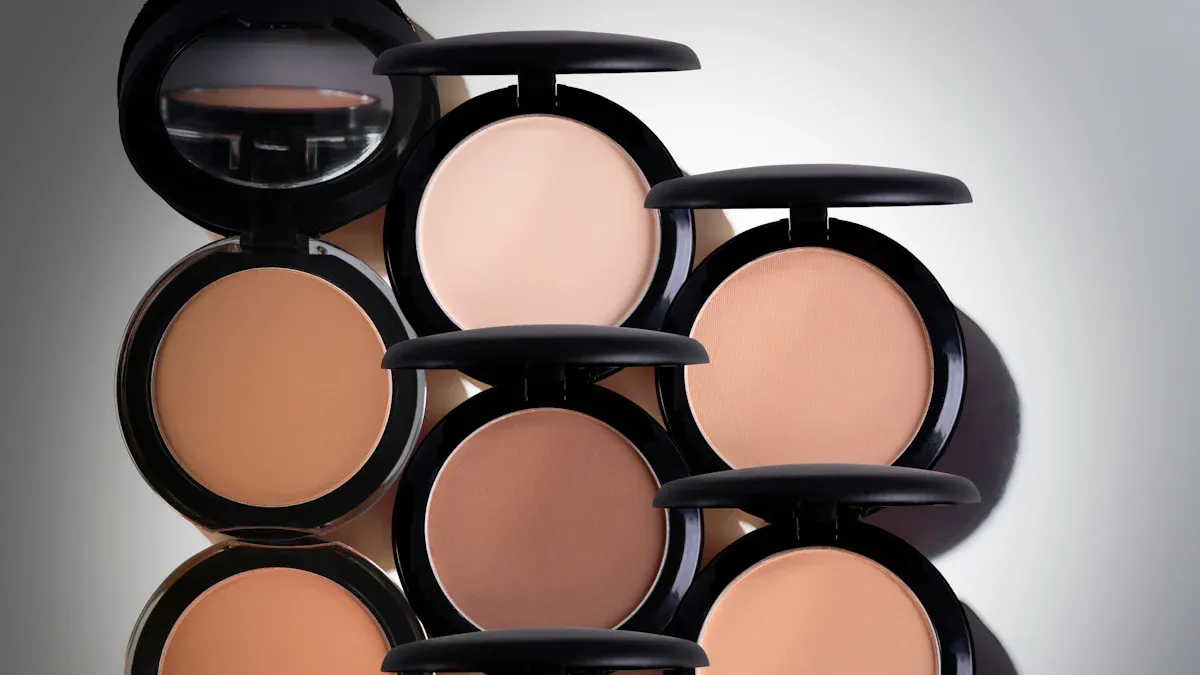
Image Source: pexels
You need to blend your powders thoroughly to achieve a uniform and high-quality compact powder. This step in the compact powder manufacturing process ensures that every ingredient is evenly distributed. You start by developing your formulation, selecting each ingredient and its percentage. Pre-screening helps you achieve even distribution and uniform particle size before blending.
You pay close attention to particle size, shape, and density. These factors affect how well your powders mix. You might use agitator bars to resize and disperse particles, which helps create a smoother blend. Sometimes, you apply spray coatings to control how active ingredients release in the final product. Static electricity can cause clumping, so you use static arrestors to prevent this problem.
Tip: Inadequate mixing can lead to product defects and uneven texture. Always check your blend for consistency before moving to the next step.
You can choose from different types of blending equipment. Low-intensity mills like ribbon blenders and paddle mixers work well for gentle mixing. High-intensity mills, such as the Henschel mixer, provide thorough blending for more challenging formulations. You also monitor factors like bulk density and moisture content to ensure a smooth and even blend.
You want every batch of compact powder to match your brand’s signature shade. Color consistency is essential for customer satisfaction and brand trust. During blending, you carefully match colors to meet your desired shade and texture. You test each batch to confirm that it aligns with your standards.
You use rigorous quality control and testing before packaging. This step ensures that your compact powder meets safety standards and performs as expected. By focusing on precise blending and color matching, you maintain consistency across all batches. This attention to detail helps you deliver a reliable product every time.
If you want to learn more about equipment that supports blending and color matching, explore Jaywin Machinery’s cosmetic powder equipment for solutions that enhance your production process.
Efficient Compact Powder Manufacturing Process with Jaywin Machinery
Discover the compact powder manufacturing process with Jaywin Machinery. Learn how advanced equipment ensures quality, consistency, and efficiency. Explore solutions now!
You reach the heart of the compact powder manufacturing process when you press and compact the blended powders. This stage transforms loose powder into a solid, smooth compact that customers love. Jaywin Machinery provides you with advanced equipment designed to deliver consistent results, whether you work in a laboratory or run a large-scale factory.
You use pressing and compaction to shape and solidify your powder blend. The process requires precise control over pressure and timing. Jaywin Machinery’s cosmetic powder equipment gives you the flexibility to adjust these parameters for different product types, such as eyeshadow, blush, and compact powder.
You achieve uniform texture and density by controlling pressure during pressing. This step prevents defects and ensures every compact powder meets your quality standards.
Jaywin Machinery’s equipment supports a wide range of product specifications. You can create powders in various shapes, sizes, and colors. Automation features help you speed up workflow, reduce errors, and improve consistency. You respond quickly to market trends and customer requests because the machinery adapts to new formulations and designs.
You benefit from:
Consistent pressure control for uniform compacts
Adjustable settings for different powder types
Fast adaptation to new product trends
Automation that reduces manual labor and errors
Explore Jaywin Machinery’s cosmetic powder equipment to see how you can enhance your pressing and compaction process.
You rely on the vacuum powder press for high-quality compact powder manufacturing. This machine uses a two-stage pressure mechanism and precision alignment devices to ensure balanced compaction. You activate the system with a dual-operation design, which keeps you safe during production.
The vacuum powder press offers:
Adjustable pressure duration and holding time
Multiple pressing cycles for challenging powders
Smooth texture and reduced risk of cracks
Vacuum systems that collect excess powder, supporting sustainability
Jaywin Machinery’s vacuum powder press helps you maintain product consistency and safety. You reduce waste and energy consumption with eco-friendly designs. The machine’s advanced features allow you to customize the compact powder manufacturing process for each batch.
Automation through the press machine reduces the intensity and need for manual labor, hence increasing your production efficiency and eliminating potential human error.
You can learn more about the Vacuum powder press for cosmetic powder compacts and eyeshadow and its benefits for your production line.
You choose between laboratory and industrial powder press machines based on your production needs. Laboratory machines work best for small batches and research. You use them to test new formulations and ensure precision. These machines feature programmable controls and handle various pressures, making them ideal for processing powders with different densities.
Industrial powder press machines suit large-scale manufacturing. You use them for high output and efficiency. These machines support continuous operation and quick switching between product recipes. You benefit from adjustable pressure settings and pressing cycles, which help you produce consistent, high-density compacts.
Laboratory machines:
Programmable controls for different pressures
Industrial machines:
Designed for high output and efficiency
Suitable for large-scale production
Support continuous operation and recipe storage
You can explore Laboratory Hydraulic Powder Press Machine for research and small-scale production. For large factories, the Industrial Powder Press Machine delivers reliable performance and high capacity.
Automation Benefit | Description |
|---|---|
Streamlined Processes | Automation enhances the speed and consistency of production, reducing errors. |
Increased Throughput | Robotic handling systems maintain smooth production flow, minimizing downtime. |
Smart automation reduces human error.
You lower operational costs and improve efficiency.
Jaywin Machinery’s advanced technology ensures you produce compact powders that meet strict quality standards. You achieve safety, consistency, and efficiency at every stage of the compact powder manufacturing process.
Tip: Choose equipment that matches your production scale and product requirements. Jaywin Machinery offers solutions for every need, from R&D labs to full-scale factories.
For more details on optimizing your compact powder manufacturing process, visit Jaywin Machinery’s service process page.
You need to perform thorough physical and chemical checks to guarantee the safety and performance of your compact powder. These tests help you identify any contamination, variability, or degradation in your product. You measure powder flow, compaction, and stability to ensure your powder applies smoothly and lasts long. You analyze particle size and shape because these factors affect surface area, dissolution rate, and density. You test density and porosity to confirm material strength and stability. Moisture and hygroscopicity testing helps you prevent clumping and maintain shelf life. You also check surface area and reactivity to understand how your powder will behave during use. Mechanical property testing lets you see how your powder responds to compression and stress.
Common physical and chemical checks include:
Performance measurement for powder flow and stability
Flowability testing to detect clumping or inconsistencies
Particle size and shape analysis for texture and application
Density and porosity testing for strength and shelf life
Moisture and hygroscopicity testing for stability
Surface area and reactivity checks for product behavior
Mechanical property testing for durability
You use these tests to maintain high standards throughout the compact powder manufacturing process. You can find equipment that supports these checks in Jaywin Machinery’s cosmetic powder equipment.
You must ensure every batch of compact powder meets your quality standards. You use advanced weighing technologies to measure ingredients accurately. Real-time monitoring and control systems help you spot discrepancies quickly. Intelligent indicators and high-accuracy weight sensors optimize your batching and packaging processes. You record details of the filling process, including weight, environmental conditions, and machine settings. This practice ensures full traceability and accountability.
You track raw ingredients from source to final product. You keep documentation for each ingredient, including origin and quality certificates. Advanced tracking systems allow you to monitor the supply chain in real time. You maintain FDA-compliant materials and documentation for every component in contact with your product. During audits, you provide verification of compliance. You integrate traceability into your manufacturing process, tracking issues back to their origin using batch numbers and production conditions.
Tip: Consistent batch quality builds trust with your customers and supports regulatory compliance.
You can learn more about maintaining batch consistency and traceability by exploring Jaywin Machinery’s service process.

Image Source: unsplash
You need to choose the right packaging materials to protect your compact powder and keep it fresh. Your choice affects durability, sustainability, and user convenience. Many manufacturers use the following materials for compact powder packaging:
Plastic, including reusable travel containers
Metal, which offers durability and can be recycled
Glass, often used for premium face powder containers
Bamboo and paperboard, popular for eco-friendly lines
These materials serve different needs. Plastic and metal provide strength and help prevent breakage. Glass gives a high-end look and protects the powder from outside elements. Bamboo and paperboard support sustainability, as they are biodegradable and recyclable. You see more brands using these options to reduce environmental impact.
Your packaging also plays a key role in product safety and shelf life. Flexible barrier packaging helps keep your powder safe from moisture and air. Resealable features prevent oxidation and keep the powder fresh. Some companies use advanced technologies, like modified atmosphere packaging, to limit spoilage and extend shelf life.
Key Factor | Description |
|---|---|
Flexible Barrier Packaging | Prevents spoilage and prolongs shelf life by keeping products safe and fresh. |
Material Compliance | Ensures packaging is suitable for the product, preventing leaks or blow-outs. |
Resealable Features | Maintains product integrity by blocking oxidation, moisture, and light. |
Tip: Always select packaging that matches your product’s needs and supports your brand’s values.
You must follow strict labeling rules to sell your compact powder in different countries. Labels need to show important information, such as ingredients, batch numbers, and expiration dates. In the European Union, you must use multilanguage labels and include batch numbers. In Canada, you need bilingual labels in English and French.
Region | Labeling Requirements |
|---|---|
EU | Multilanguage labels, batch numbers, expiration dates |
Canada | Bilingual labeling: English and French required |
Accurate labeling helps consumers make safe choices. You list all ingredients so users can avoid allergens. You include risk warnings and clear instructions to prevent misuse. Regulatory agencies, like the FDA, check labels to protect consumers and ensure safety standards.
Clear instructions help prevent mistakes.
Compliance builds trust and supports your brand’s reputation.
You can find more about cosmetic labeling and compliance in Jaywin Machinery’s service process, which supports every step of the compact powder manufacturing process.
You see that every step in the compact powder manufacturing process matters. Careful ingredient selection, precise blending, and advanced pressing shape the quality and safety of your product. Jaywin Machinery’s equipment helps you achieve high material efficiency, design flexibility, and consistent results. Modern technology also supports sustainability and innovation in your production.
Benefit | Impact on Your Production |
|---|---|
High Efficiency | Reduces waste and saves costs |
Consistent Quality | Delivers reliable results every batch |
Sustainable Solutions | Supports eco-friendly manufacturing |
Value the expertise and technology behind each compact powder. For advanced solutions, explore Jaywin Machinery’s products or contact us today!
You blend, grind, and press cosmetic powders into solid compacts. You use advanced machines like a vacuum powder press to ensure consistency, safety, and quality.
Learn more in our compact powder equipment guide.
You control particle size to create a smooth texture and even application. Fine particles help your powder feel silky and last longer on the skin.
You use Jaywin Machinery’s automated equipment to reduce manual labor, speed up production, and maintain consistent quality.
Automation lowers errors
Smart controls store recipes for quick changes
Yes. You can choose the Laboratory Hydraulic Powder Press Machine for R&D or small batches. It offers precise control and easy operation.
You stay safe with dual-operation controls, pressure sensors, and vacuum systems that collect excess powder. These features protect you and keep your workspace clean.


