
English


Views: 0 Author: Site Editor Publish Time: 2026-02-12 Origin: Site


Understanding shear stress cosmetics is vital if you want to create stable, high-quality cream formulations, especially for sensitive products. Shear stress cosmetics directly influences how your creams hold up during storage and use. Have you ever noticed cream separation or changes in texture after production? This often links back to how shear stress cosmetics impact viscosity, texture, and stability. Recent industry reports show that predicting rheological properties through shear stress cosmetics helps you maintain consistent product quality.
Aspect |
Description |
|---|---|
Rheological Properties |
Shear stress cosmetics allow you to predict formulation behavior and stability. |
Viscosity Correlation |
Shear stress cosmetics relate to viscosity, which keeps cream structure intact. |
Patient Compliance |
Shear stress cosmetics help your creams flow well while holding their shape. |
When you focus on shear stress cosmetics, you also address consumer needs for personalized, effective creams. You must select active ingredients and cream bases that respond well under shear stress cosmetics, enhancing product satisfaction. Jaywin Machinery gives you advanced equipment to control shear stress cosmetics during production, ensuring your creams remain stable and meet high standards.
Yield stress and high shear viscosity guide packaging and dispensing choices for your creams.
Elasticity under shear stress cosmetics ensures product stability and usability.
Thixotropic behavior, driven by shear stress cosmetics, affects processing and application quality.
Understanding shear stress is crucial for creating stable cosmetic creams. It affects texture, viscosity, and overall product quality.
Control shear stress during production to prevent issues like cream separation and texture changes. This ensures a consistent user experience.
Choose the right mixing method—high shear for fine emulsions and low shear for delicate ingredients—to optimize cream stability.
Utilize advanced equipment from Jaywin Machinery to maintain precise control over shear rates and temperatures, enhancing product integrity.
Regularly test rheological properties to ensure your creams meet industry standards and consumer expectations for quality and performance.
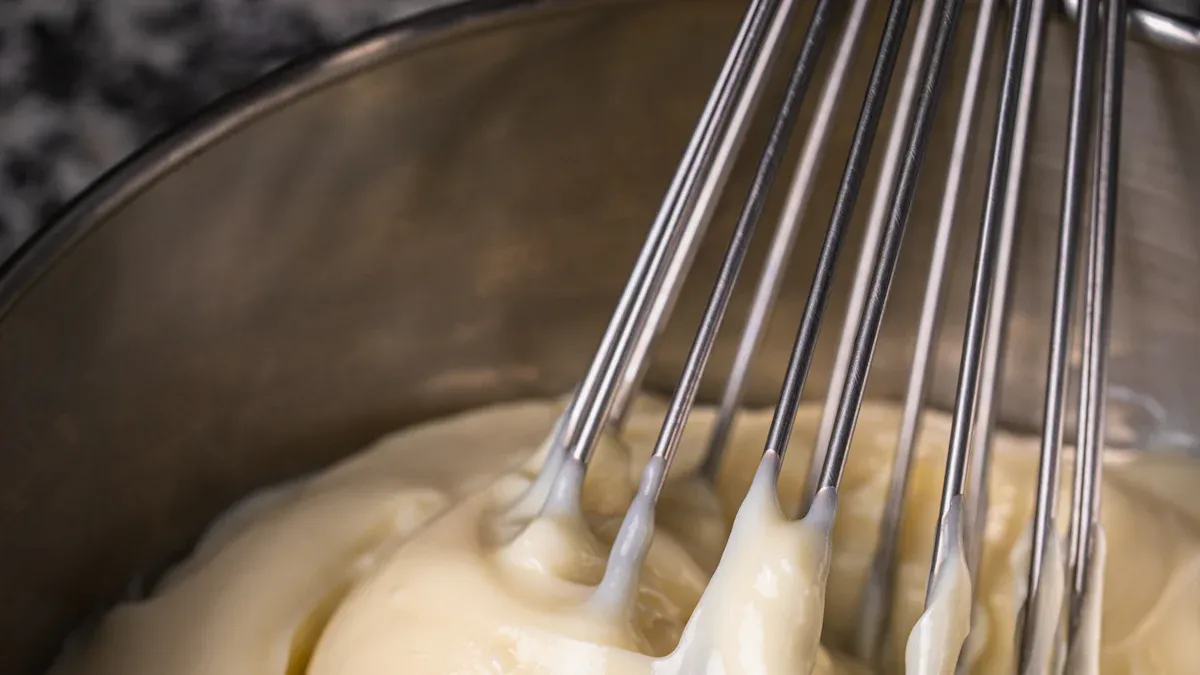
Image Source: pexels
You need to understand how shear stress shapes the structure and texture of every cream you produce. When you mix topical formulations, you apply force that breaks down droplets and disperses ingredients. This process changes the properties of your emulsions and determines how your creams feel and perform on the skin.
Mechanism |
Description |
|---|---|
Droplet Size Reduction |
Increased shear rates lead to smaller droplet sizes, enhancing stability. |
Increased Droplet Packing |
Smaller droplets result in higher packing density, contributing to emulsion stability. |
Narrower Droplet Size Distribution |
A more uniform droplet size distribution improves overall emulsion performance. |
You see these mechanisms at work in topical creams, semisolid dosage forms, and gels. Smaller, evenly distributed droplets give your creams a smooth texture and help maintain ingredient integrity. When you control shear stress, you can create topical formulations that deliver consistent properties and a pleasant sensory experience.
The way a cream feels on the skin depends on its rheological properties. The primary sensation you notice when applying a cream comes from the onset of flow and dynamic viscosity. The secondary sensation relates to how the cream settles and stays on your skin. If you want your topical creams, serums, and gels to provide the right feel, you must manage shear stress during production. This approach preserves ingredient integrity and ensures the efficacy of sensitive actives and other active ingredients.
Jaywin Machinery offers advanced cosmetic cream equipment that gives you precise control over shear rates. With features like servo piston filling and heating systems, you can fine-tune the mixing process for your topical formulations. This technology helps you maintain the integrity of your emulsions, protect ingredient sensitivity, and achieve the desired texture in every batch.
Sensitive creams, such as those containing delicate gels or sensitive actives, face unique challenges during production. If you do not manage shear stress carefully, you risk destabilizing your topical formulations and compromising their shelf life. Scientific studies show that the stability of emulsions depends on how you control shear during mixing and filling. Measuring zero-shear viscosity can help you predict long-term stability and minimize destabilization.
Common stability issues in sensitive creams include:
Changes in shear distribution can lead to instability in emulsions during production.
Thermal gradients can create uneven heating and cooling, affecting temperature-sensitive emulsification systems.
Increased residence time during scale-up can result in droplets colliding without sufficient interfacial protection, leading to coalescence.
Emulsifiers may require time to hydrate and orient, making them vulnerable during the scale-up process.
You must also consider ingredient sensitivity. Polymeric emulsifiers, such as those found in many topical gels and semisolid dosage forms, create gel networks around oil droplets. These ingredients are sensitive to both electrolytes and shear. If you apply too much force, you can break these networks and reduce the integrity of your cream.
Ingredient Type |
Examples |
|---|---|
Non-Newtonian Fluids |
Cornstarch, Xanthan Gum |
Polymeric Emulsifiers |
Sepigel 305, Sepiplus 400 |
When you scale up production, you face new challenges. High shear mixers help break down fat globules and ensure uniform dispersion, but they can also degrade sensitive ingredients. Scaling up can introduce variability in shear rates, making it harder to maintain consistency in your topical formulations.
Jaywin Machinery addresses these challenges with equipment designed for precise temperature and shear control. The heating and filling systems allow you to tailor production parameters to each formula, protecting ingredient integrity and ensuring the efficacy of your creams. Automated controls and multi-color filling options help you maintain quality across diverse product lines.
If you do not manage shear stress properly, you risk product recalls and customer complaints. Packaging and applicators may fail under stress, leading to leaks and contamination. This not only affects the properties of your creams but also damages your reputation.
By choosing Jaywin Machinery, you gain the ability to optimize every step of your topical cream production. You can protect ingredient integrity, maintain the properties of sensitive actives, and deliver stable, high-quality topical formulations that meet consumer expectations.
You need to understand rheology to create cosmetic creams that perform well. Rheology is the study of how materials flow and change shape when you apply force. In cosmetic cream formulation, rheology helps you predict how your product will behave during mixing, filling, storage, and application. This knowledge lets you design creams that spread easily, feel pleasant, and stay stable over time.
Aspect |
Description |
|---|---|
Definition |
Rheology is the study of the flow and deformation of materials under applied forces. |
Importance |
It helps characterize material behavior, ensuring optimal performance and processability in cosmetics. |
You must pay attention to rheological properties like viscosity, yield stress, and relaxation time. Viscosity measures how much a cream resists flow. When you apply force, such as spreading cream on your skin, viscosity decreases. This makes the cream easier to spread and gives a smooth sensation. Rheological properties also affect how your cream feels, how well it stays on the skin, and how long it remains stable.
Creams are emulsions that show a rapid decrease in viscosity when you apply force, which improves spreadability.
Rheological properties determine sensory attributes, stability, and functional performance.
Viscosity control enhances the application sensation of creams and emulsions.
You can see that rheology is essential for both product development and consumer satisfaction.
You need reliable methods to measure rheological characteristics and ensure quality control. Rheological testing helps you evaluate the spreadability, texture, and stability of your creams. Common tests include flow curve analysis and amplitude sweep testing using a rheometer. These tests measure yield stress and other rheological properties. Texture analyzers also provide objective data on spreadability, hardness, and work of shear.
Rheology involves studying material flow and deformation, which is crucial for assessing the spreadability of creams and gels.
Yield stress can be measured using a rheometer through flow curve analysis or amplitude sweep testing.
Texture analyzers measure spreadability, hardness, stiffness, and work of shear.
Rheology testing is important for compliance with industry standards. It gives you insights into the physical properties of your creams, which affect quality, stability, and user acceptance. Understanding rheological behavior helps you predict how your product will perform over time and during use.
Jaywin Machinery supports you in maintaining consistent rheological properties. The mixers from Jaywin Machinery provide precise mixing for different viscosities and formulations. You can handle various batch sizes and prevent separation or air bubbles. The equipment meets industry standards for quality and hygiene, helping you produce creams with reliable rheological characteristics every time.
Tip: Consistent rheological properties lead to stable, high-quality creams that meet both regulatory and consumer expectations.
Image Source: pexels
You must choose the right mixing method to achieve stable cosmetic creams. High shear mixing and low shear mixing each offer unique benefits for different formulations.
Low shear mixing uses gentle force. You preserve delicate ingredients and maintain coarse textures. This method works best for creams that do not require fine emulsions.
High shear mixing applies significant force. You create homogeneous mixtures and break down particles efficiently. This method is ideal for fine emulsions and for incorporating powders into creams.
High shear mixing ensures even distribution of pigments and active ingredients. You achieve a uniform particle size distribution, which improves cream stability and texture. Scientific studies show that high shear mixers create stable emulsions by breaking up droplets into smaller sizes. You can optimize droplet diameter by adjusting mixer height, time, and speed.
Key Findings |
Description |
|---|---|
Emulsion Stability |
High shear mixers create stable emulsions by efficiently disrupting the dispersed phase into small droplets. |
Droplet Size Optimization |
You can optimize droplet diameter through careful selection of mixer height, time, and speed. |
Energy Dissipation Rate |
Increasing mixer speed elevates localized energy dissipation, improving droplet breakage efficiency. |
High shear mixing is essential in the cosmetics industry for developing stable emulsions and achieving homogeneous product formulations. You also benefit from energy efficiency, as modern mixers reduce processing times and energy usage while maintaining high-quality standards.
You need to consider several criteria when selecting mixing equipment for cosmetic cream production. The right choice ensures optimal shear control and consistent product quality.
Criteria |
Description |
|---|---|
Powder Type and Dispersion |
Different powders require varying levels of mechanical energy for uniform integration. |
Production Capacity and Batch |
Larger batches need higher torque and shear capabilities for consistency. |
Viscosity Range |
Higher-viscosity formulations require stronger mechanical energy and advanced mixing designs. |
Temperature Control |
Some formulations are sensitive to temperature, so mixers with controlled heating or cooling are necessary. |
Emulsification Integration |
Many creams require simultaneous powder dispersion and emulsification, making integrated systems beneficial. |
Jaywin-machinery offers advanced cosmetic cream equipment that meets these criteria. You can explore their Cosmetic Cream Equipment for solutions that provide precision filling, heating, and freezing. Features such as ±0.1ml filling accuracy, adjustable filling speed, and preheating functions up to 140℃ help you maintain ingredient homogeneity and eliminate air bubbles. Independent heating and stirring systems, along with digital temperature control, ensure stability for temperature-sensitive ingredients.
Feature |
Description |
|---|---|
Filling Accuracy |
±0.1ml, ensuring uniform weight and appearance of each product. |
Adjustable Filling Speed |
Ranges from 30-75 molds/hour, allowing for flexibility in production rates. |
Preheating Function |
Built-in function up to 140℃ to reduce flow resistance and eliminate air bubbles in high-viscosity materials. |
Independent Heating and Stirring |
Dual 20L SUS316L barrels with independent systems to maintain ingredient homogeneity. |
Stirring Speed |
Steplessly adjustable from 0-90 rpm/min to prevent material separation. |
Temperature Control |
Digital controller maintains stability of ±2℃, critical for preserving temperature-sensitive ingredients. |
You can also consider the Four-head Cosmetic paste heating, filling and freezing production line for streamlined operations. This equipment supports quantitative filling, uniform heating, and effective freezing, which are crucial for cream stability.
You can optimize your production process by following practical steps with Jaywin Machinery solutions:
Implement smart automation to reduce human error and streamline workflow.
Select equipment that matches your production scale and product requirements.
Perform thorough physical and chemical checks to ensure product safety and performance.
Use advanced weighing technologies for accurate ingredient measurement.
Maintain traceability of raw ingredients from source to final product.
Jaywin-machinery integrates the latest technological advancements in mixing equipment. High shear mixing technology enhances the precision of shear stress control. Vacuum emulsification ensures emulsion stability. Planetary mixing allows for thorough blending of ingredients. Advanced micromixer technology improves mixing efficiency, even at low flow rates. Touch screen interfaces and programmable settings give you greater control and customization.
Efficient mixing is essential for achieving product quality in cosmetic creams. Advanced mixing technologies, such as high shear and vacuum emulsifying mixers, enhance efficiency and lower energy costs. Automated controls and real-time monitoring optimize energy consumption and minimize waste. You also support sustainability goals by reducing labor, minimizing errors, and maintaining consistent product quality. Upgrades and retrofitting add value to your equipment, extending machine lifespan and supporting eco-friendly practices.
Tip: You can visit the Jaywin Machinery Service Process page to learn more about how to implement these solutions for your cosmetic cream production.
You gain a competitive edge by choosing Jaywin-machinery for your mixing needs. You ensure stable, high-quality creams that meet both regulatory and consumer expectations.
You play a critical role in ensuring cosmetic cream stability by understanding and controlling shear stress and rheology. Recent research shows that controlling shear stress leads to non-Newtonian flow and stable viscosity, which supports long-term cream stability. The table below highlights key findings:
Key Findings |
Description |
|---|---|
Emulsions show non-Newtonian flow, with viscosity decreasing as shear increases. |
|
Viscosity Trends |
Creams with clays show more viscosity changes than gels, which stay uniform. |
Stability Over Time |
Some emulsions increase in viscosity after 90 days, showing changes in flow. |
Jaywin-machinery helps you achieve high production efficiency and maintain strict hygiene standards. Advanced machinery reduces energy use, lowers costs, and minimizes waste. You also meet FDA and GMP requirements, which ensures consistent product quality and reduces contamination risks.
Evaluate your current process and consider Jaywin-machinery for your next step. Contact Jaywin-machinery today to explore solutions that will help you deliver stable, high-quality creams every time.
You apply shear stress when you mix or pump creams. This force changes the structure of your cream. You need careful analysis to see how shear stress affects texture and stability. Jaywin-machinery equipment helps you control this process for better results.
Mixing methods change how ingredients blend. High shear creates small droplets. Low shear keeps larger particles. You use analysis to decide which method works best for your formula. Jaywin-machinery offers machines that let you adjust mixing for stable creams.
You use tools like rheometers for analysis of viscosity and flow. These tools show how your cream moves under force. Jaywin-machinery equipment supports consistent analysis, so you can check quality and make improvements.
If you skip analysis and do not control shear stress, your cream may separate or lose texture. You might see air bubbles or uneven color. Jaywin-machinery helps you avoid these issues with precise mixing and analysis.
Jaywin-machinery gives you advanced machines for analysis and production. You can set mixing speed, temperature, and filling accuracy. This analysis ensures your creams stay stable and meet high standards.


