
English


Views: 0 Author: Site Editor Publish Time: 2026-11-03 Origin: Site


Helping a Thai client launch a full skincare brand comes down to five moves: consultation and formulation support, the right equipment for each production stage, regulatory alignment, on-site installation and training, and service that continues after the line runs. That's how Jaywin Machinery guides brands from first call to first batch.
Compliance shapes every equipment decision, so plan for it early — general cosmetics registration in Thailand typically runs about 3–5 months from document prep to notification. From there, machine choice, cost, and configuration follow your product mix and volume.
Ready to start? Share your product plans, and we'll map the equipment to match.
Start with a consultation to match equipment to your product types and budget.
Choose equipment that fits your production stage, from small-batch testing to high-volume lines.
Plan for Thai FDA registration early; it typically takes 3–5 months.
Use GMP-aligned machines with stainless steel and CIP cleaning for easy compliance.
Leverage after-sales support, including training and 24/7 online help, to keep production running.
Thailand's private label and OEM/ODM scene is crowded and friendly to newcomers. Local contract manufacturers often accept low minimum order quantities, with some starting around 500 units. That number matters for your equipment plan. A 500-unit run rewards small, flexible machines over giant lines. You can test a formula, fix a label, and learn your real demand before you commit capital.
Think about your endgame early. Many founders start with an OEM partner and later bring production in-house. When that day comes, you want machines that scale with you. A single-head filler today can sit beside a four-head line tomorrow. Plan the floor space and power supply now, even if the second machine arrives next year.
The Thai FDA, under the Ministry of Public Health, regulates cosmetics. The Cosmetics Act B.E. 2558 (2015) sets the rules, and Thailand follows the ASEAN Cosmetic Directive. Only a Thai-registered entity can hold a notification, so foreign brands work through a subsidiary, distributor, or compliance partner.
Notification comes before you manufacture or import for sale. You'll need a full formulation with INCI names, a GMP certificate, Thai label artwork, and a Letter of Authorization. The notification stays valid for three years. Labels must be in Thai and carry the notification number.
Testing is largely self-regulated. Recommended checks include:
Safety tests
Efficacy tests to back your claims
Stability testing over time
Biomarker analysis of active ingredients
Independent verifiers often run these. Build the results into your product file, because the Thai FDA can audit after launch.

Creams and powders sit at the heart of most skincare and color lines. Jaywin's cosmetic cream equipment covers the filling side well. Servo piston and gear pump systems handle thin lotions and thick creams alike. Heating keeps waxy formulas flowing. Multi-color filling lets one machine run several shades without a second setup. That fits a brand selling foundations, BB creams, and concealers from a single floor.
Powder needs a different touch. Loose powder, eyeshadow, and blush all behave differently under a nozzle. The cosmetic powder equipment range splits the job by stage:
Equipment | Specifications | Applications |
|---|---|---|
Automatic powder filling machines | Servo-driven augers for precise powder flow control; quantitative filling | Loose powders; reduces product giveaway and keeps batch weights consistent |
Eyeshadow and blush powder filling machines | Versatile across pan sizes; quick-change tooling; handles single pans and multi-well compacts | Eyeshadow and blush filling with accuracy and minimal downtime |
Vacuum powder presses | High-pressure compaction; vacuum chamber removes trapped air; captures excess powder | Pressed powders; prevents cracking, ensures smooth surfaces, cuts waste |
Laboratory hydraulic powder presses | Adjustable pressure settings | R&D and small-batch production; testing binder levels and powder density before scale-up |
A new brand usually starts with the lab press. Test your binder level and pressing pressure there. Move to the vacuum press once the formula holds. Food-grade stainless steel and quick-release parts make color changes faster.
Lipstick rewards precision. The 12-hole lipstick filling machine fills twelve sticks per cycle with ±0.05 g accuracy. Output lands between 2,500 and 5,000 sticks per hour. The 140℃ preheating function matters for matte formulas. It cuts flow resistance and keeps air bubbles out. CIP cleaning handles changeovers, and the control system stores up to 50 formulas. Filling range runs 1–11 ml, so lip balm and gloss share the same machine.
Paste products need heat and cold in one pass. The four-head cosmetic paste heating, filling and freezing production line runs 80–160 pcs/min. PLC control keeps the cycle steady. A 5P compressor drives the freezing tunnel, which sets cooling oils, hair wax, and pot lipstick fast. Choose this line when volume justifies the footprint. Choose the 12-hole machine when lipstick is your focus and you want a compact start.
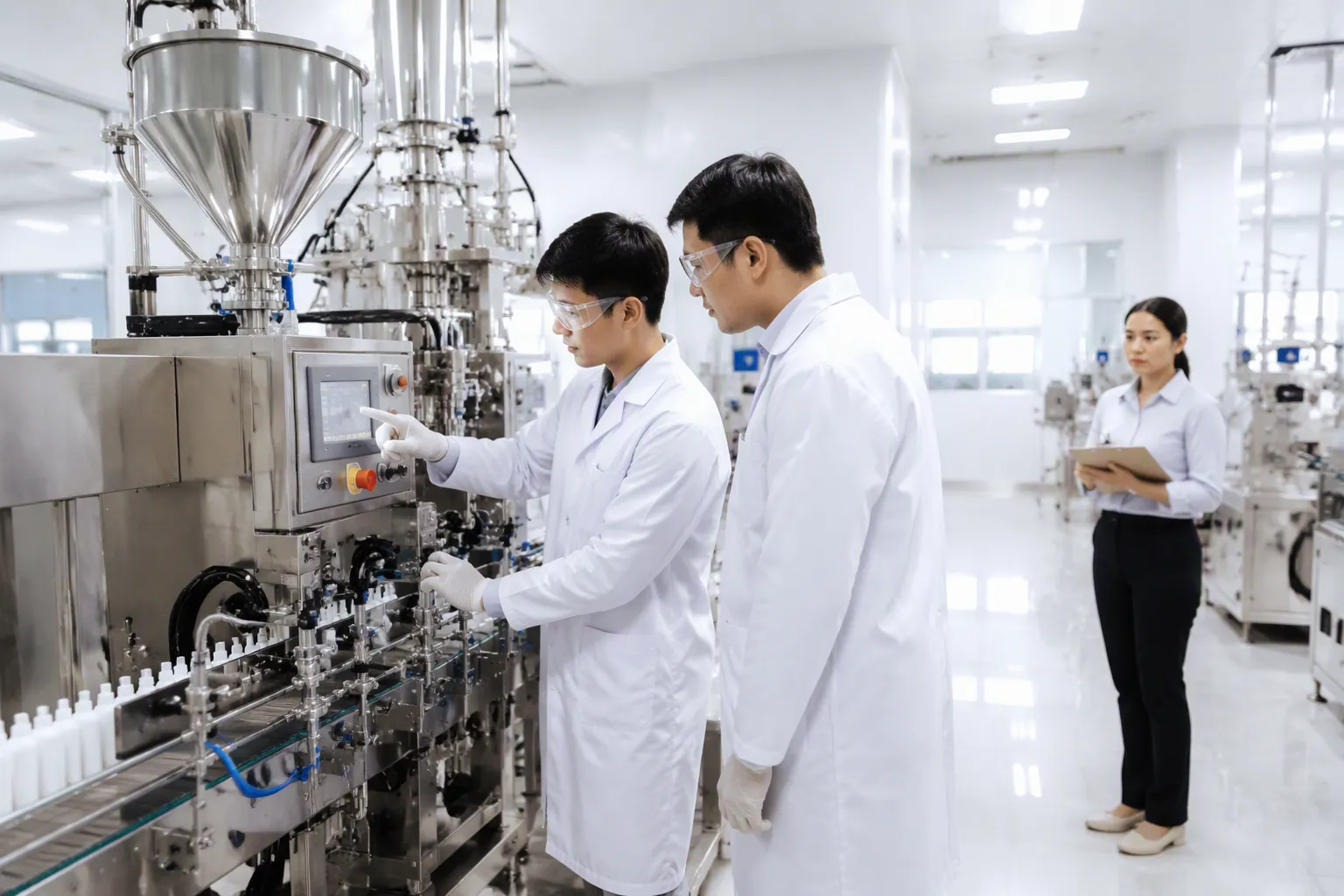
Every project starts with a conversation. You tell us your product types, capacity targets, existing production conditions, budget, and timeline — by phone, email, meeting, or online call. Our team analyzes those requirements and decides whether customized or standardized equipment serves you better. You get a preliminary proposal with configuration suggestions and rough cost estimates.
From there, we refine the technical proposal: equipment parameters, line layout, supporting systems, and any special functionality your formulas demand. A detailed cost calculation and formal quotation follow, covering payment terms and delivery schedules. Technical exchange meetings let both sides adjust the proposal until it fits. Once you confirm and sign, production begins.
Production follows a set schedule. We procure standard parts and precision-process custom components to hygiene standards, then assemble and debug each machine and the integrated line under simulated production. Quality inspection checks ISO/GMP alignment, safety, and hygiene before anything ships. Custom packaging and professional logistics with tracking carry the equipment to Thailand. Our engineers survey your site and guide preparatory work, then assemble on-site, connect utilities, run no-load and load test runs, and adjust parameters to optimal conditions.
Jaywin Machinery's service process covers consultation, proposal, production, installation, training, and after-sales support — a step-by-step approach that keeps projects on track and ensures safety.
Installation ends with knowledge transfer, not a handshake. Your operators learn equipment operation, fault handling, and maintenance routines. Training covers daily, weekly, and monthly checks, so small issues get caught before they become stoppages. Once production runs succeed, both sides complete a formal acceptance — you sign off on a line that meets the agreed standards.
After-sales support continues long after acceptance:
Term Category | What We Offer |
|---|---|
Standard warranty | Publicly referenced 2-year warranty; exact coverage may vary by model, component, market, and distributor agreement |
Support channels | 7*24 online customer service; remote troubleshooting via video and photo diagnostics |
Software/system support | Free system upgrades, interface and language updates, parameter menu optimization |
Spare parts & maintenance | Spare parts availability, component-level diagnosis, routine maintenance guidance |
Out-of-warranty service | Paid parts, shipping, or service fees for post-warranty or misuse-related damage |
Warranty claims move faster with complete information: company and contact details, model and serial number, purchase date, issue description, photos or videos, error messages, and a short video of the operating steps. Consumables and wear parts — filters, tips, cartridges, needles, lamps, O-rings, tubes, gels — usually sit outside standard warranty or under separate usage-based terms. Unauthorized repair, incorrect voltage, cooling failures, physical damage, and out-of-manual operation fall outside coverage too.
Upgrade and retrofit services handle capacity expansion or product iteration later. Add a filling head, swap tooling for a new compact size, or refresh the control interface — the line grows with your brand instead of being replaced.
Thai hygiene rules reward equipment that's easy to clean and easy to prove clean. Jaywin builds to GMP-aligned design, with 304/316 stainless steel on product-contact surfaces. Those grades resist the ingredients and cleaning agents your formulas use, so the metal doesn't react with the batch. CIP cleaning lets you flush the line between runs without tearing it apart. Parameter accuracy — the ±0.05 g on the lipstick production equipment, for example — keeps fill weights consistent, which supports batch records and quality checks.
GMP also asks you to qualify the equipment lifecycle. That means installation qualification, operational qualification, and performance qualification, usually shortened to IQ/OQ/PQ. Keep equipment "in status" with calibration tracking, and qualify utilities like HVAC, compressed air, and purified water. Don't run a validated process on unvalidated equipment. If status lapses mid-batch, pause, assess the impact, and document a deviation before release.
Registration lives or dies on paperwork, and equipment records are part of that file. Jaywin supplies the documents your Thai notification and audits will ask for: equipment specifications, material certificates for stainless steel contact parts, cleaning and maintenance procedures, and calibration records where applicable. These tie machine use to batch traceability, which is exactly what a GMP review looks for.
We also help you align product records with equipment records — matching a filling parameter to a batch number, for instance. Your Thai-registered entity still files the notification, but the equipment side of the file arrives organized. That shortens the back-and-forth with reviewers and keeps your powder compact equipment and cream lines audit-ready from day one.
Cost talks, but performance decides. Compare options on four fronts: technical performance, application fit, regulatory compliance, and price. A laboratory hydraulic powder press and a large-scale vacuum press both press powder — one tests, one produces. The lab press costs less and fits a bench. The vacuum press removes trapped air and captures excess powder, so it earns its price at volume. Neither is "better." They answer different questions.
The same logic applies to single machines versus the integrated four-head paste line. A standalone filler handles one job at a modest footprint. The four-head line runs 80–160 pcs/min with heating, filling, freezing, rewarming, and capping in one pass. It costs more upfront and needs more floor space. Compliance is a wash — both are built to GMP-aligned design with 304/316 stainless steel. Your formula and volume pick the winner.
Match the machine to your stage of growth:
Stage | Best Fit | Why |
|---|---|---|
Small-batch and testing | Laboratory hydraulic powder press; single-head fillers | Low cost, small footprint, fast formula iteration |
Mid-volume cream and lipstick | 12-hole lipstick filling machine; servo piston cream fillers | ±0.05 g accuracy, 50 stored formulas, 1–11ml range, CIP cleaning |
High-volume integrated | Four-head paste heating, filling and freezing line | 80–160 pcs/min, PLC control, 5P compressor, one continuous flow |
Here's how that plays out. A Bangkok founder came to us planning a lip balm and compact powder line. We started with the lab press and a single filler for samples, then added the 12-hole lipstick machine once orders grew. Registration ran alongside installation, so the first compliant batch shipped without a stall. That's the pattern behind helping a Thai client launch a full skincare brand — start lean, scale on evidence.
Launching a skincare brand in Thailand follows a clear path. You start with a consultation, pick equipment that matches your product mix and volume, align the line with Thai FDA and GMP expectations, then install, train, and lean on after-sales support. Jaywin's cream, powder, lipstick, and paste lines each slot into that path, and the service process carries you from first call to first compliant batch.
Helping a Thai Client Launch a Full Skincare Brand works best when the equipment plan matches your stage of growth. So share your product plans with us today. Request a consultation at Jaywin Machinery, and we'll send a tailored recommendation for the Thai market.
Thai OEM partners often start near 500 units, and our smaller machines match that scale. A laboratory hydraulic powder press and single-head fillers let you test formulas and short runs before you commit to a full line. You scale up once demand proves itself.
Plan for registration and installation to run side by side. Thai cosmetic notification typically takes about 3–5 months. Equipment production, shipping, and on-site commissioning add their own window. Starting both tracks early keeps the first batch from stalling.
Not always. If lipstick is your core product and orders are growing, the 12-hole machine earns its place with ±0.05 g accuracy and 50 stored formulas. A brand still testing shades can begin smaller and add capacity later.
You receive equipment specifications, material certificates for stainless steel contact parts, cleaning and maintenance procedures, and calibration records where applicable. These support your Thai FDA notification and GMP audits. Your Thai-registered entity still files the notification itself.
Reach our 7*24 online support for remote troubleshooting by video or photo. Warranty coverage applies during the warranty period, and spare parts stay available afterward. Routine maintenance guidance helps you catch small issues before they stop production.


