
English


Views: 0 Author: Site Editor Publish Time: 2026-10-08 Origin: Site


Cosmetic machinery design directly determines product quality, batch consistency, and the ability to scale production. Core mechanical structures are the physical systems—filling, mixing, emulsification, and pumping—that handle raw materials and form the final product. These structures define how a machine performs across a spectrum from Huayang filling, which prioritizes high-throughput production, to Top Lab, which focuses on small-batch precision. This range highlights critical design trade-offs between speed, accuracy, and flexibility. What mechanical principles ensure both efficiency and precision in cosmetic manufacturing? Answering this question requires examining how each component manages material flow, shear forces, and thermal control under real operating conditions.
Cosmetic machinery design relies on three core structures: filling, mixing, and pumping systems.
Filling systems must balance speed and accuracy to ensure consistent product doses.
Mixing and emulsification units control texture, stability, and shelf life of cosmetics.
Pumping mechanisms must match product viscosity and shear sensitivity to avoid damage.
Material compatibility, precision, and hygiene are critical design parameters for all equipment.
Top Lab equipment offers flexibility for small-batch R&D with manual adjustments.
Huayang filling lines deliver high-throughput production with automated precision.
Integration and control systems synchronize all stages for scalable, efficient manufacturing.
Every piece of beauty equipment rests on three mechanical pillars: filling systems, mixing and emulsification units, and pumping mechanisms. These core structures determine how a machine handles raw materials, maintains product quality, and supports consistent batch output. Understanding their design trade-offs is central to effective cosmetic machinery design.
Filling systems transfer a precise volume of cosmetic product into containers. The choice of mechanism depends on product viscosity, shear sensitivity, and target throughput. Volumetric systems use pistons or peristaltic pumps to measure each dose. Gravimetric systems rely on weight feedback for accuracy. Piston fillers work well for creams and thicker liquids. Peristaltic pumps handle sensitive formulations without contamination. Nozzle design controls drip and stringing. Temperature regulation keeps materials at the correct viscosity. These factors together determine fill accuracy and production speed.
Mixing and emulsification units create stable, uniform blends. Rotor-stator emulsifiers apply high shear to break droplets into fine sizes. This process stabilizes emulsions like creams and lotions. Planetary mixers handle thick pastes and powders. Anchor mixers scrape vessel walls to prevent buildup. Homogenization controls droplet size, which directly affects product texture and shelf life. Temperature control via jacketed vessels maintains optimal processing conditions. Vacuum systems remove air bubbles. The table below summarizes key technical specifications for these units.
Mechanical Structure | Technical Specifications | Industry Standards / Compliance |
|---|---|---|
High homogenization capacity to prevent ingredient separation; precise temperature control for emulsion stabilization | Hygienic design and easy-to-clean construction complying with industry regulations | |
Reactors | Automatic temperature regulation for controlled, consistent processes; recirculation and emulsification systems for mixture stability; vacuum and controlled pressure options to prevent air entrapment | Designed to meet safety standards required in the cosmetics industry |
Industrial Mixers | Precise mixing speed control to avoid over-processing or phase separation; optional vacuum systems to prevent bubble formation | Hygienic stainless steel design ensuring a safe and easy-to-clean production environment |
These specifications highlight the need for precise control over shear, temperature, and vacuum parameters.
Pumping mechanisms move materials between process stages. Positive displacement pumps deliver a fixed volume per cycle, making them ideal for viscous creams and gels. Progressive cavity and peristaltic pumps handle thick products without altering texture. Lobe pumps suit shear-sensitive formulations. Flow control systems maintain consistent transfer rates. Cleanability matters because product residues can cause contamination between batches.
Three design parameters cut across every mechanical structure: material compatibility, precision and repeatability, and hygiene and cleanability.
Contact parts must resist cosmetic ingredients. Stainless steel 304 and 316L are standard. Grade 316L contains molybdenum for added corrosion resistance against aggressive agents. Aluminum works for non-contact frames. Plastics like PP, PVDF, and PTFE serve in seals, gaskets, and liners. Material choice must comply with ASTM, DIN, JIS standards, the EU Machinery Directive, and FDA or EU food-contact guidelines. RoHS and REACH regulations also apply. The wrong material leads to corrosion, contamination, or regulatory rejection.
Precision ensures consistent product quality. Common tolerances reach ±0.1 mm. Surface finish for contact parts should be Ra below 0.8 micron to prevent microbial growth. Filling accuracy targets ±0.1 mL for high-end machines. Homogenization speed and shear rates must be tightly controlled. ISO 9001 quality management systems certify consistent process control. Calibration verification and Factory Acceptance Testing (FAT) validate performance before delivery.
Hygiene design minimizes contamination risk. Clean-In-Place (CIP) systems allow cleaning without disassembly. GMP-compliant design features reduce microbial harborage points. Equipment must carry CE Marking for European markets. Additional regional certifications include UL for US electrical safety, KEBS for Kenya, Gulf Conformity Mark or SASO for the Middle East, and INMETRO for Brazil. Quality control checkpoints include Incoming Quality Control (IQC) for raw materials, In-Process Quality Control (IPQC) for weld and torque checks, and Final Quality Control (FQC) for performance testing. These measures reduce downtime and labor costs.
The spectrum from Top Lab to Huayang filling illustrates how mechanical design adapts to different production scales.
Top Lab equipment prioritizes flexibility over speed. Benchtop systems allow R&D teams to test formulations with small volumes. Manual adjustments give operators fine control over parameters. Mixing vessels, pumps, and fillers are modular. This setup helps formulators validate recipes before committing to full-scale production. The trade-off is lower throughput and higher per-unit labor.
Huayang filling lines maximize output while maintaining quality. Automated systems handle thousands of units per hour. Servo-driven pistons achieve accuracy of ±0.1 mL at high speed. CIP systems enable rapid changeovers between products. Integration with upstream mixing and downstream packaging creates a seamless workflow. The capital investment is higher, but operational efficiency reduces long-term costs. Consistency across batches builds brand trust.
Image Source: unsplash
A filling system transfers a measured product dose into a container. This process may seem straightforward, but achieving both speed and accuracy for cosmetics requires careful engineering. In cosmetic machinery design, the choice between volumetric and gravimetric principles, the selection of piston or peristaltic mechanisms, and the control of nozzle behavior all affect final product quality.
Volumetric filling measures each dose by volume. A cylinder displaces a set amount of product, making it fast and repeatable. Gravimetric filling measures each dose by weight. A load cell provides real-time feedback, allowing the system to adjust on the fly. The table below compares these two technologies for viscous cosmetic products.
Filling Technology | Accuracy | Throughput | Suitability for Viscous Cosmetics |
|---|---|---|---|
Volumetric (servo-driven piston) | ±0.1 mL | 20–70 pieces per minute | High-viscosity creams, pastes, gels; handles particulates |
Gravimetric (mass flow) | Real-time gravimetric verification with closed-loop feedback control | No specific throughput data available for viscous cosmetics | Preferred when density varies; pinnacle of dosing technology |
Volumetric systems dominate high-speed production lines. They deliver fast cycles with minimal variation. Gravimetric systems serve applications where product density changes between batches or when temperature shifts affect volumetric accuracy. The closed-loop feedback in gravimetric units ensures every container meets target weight. For most cosmetic creams and lipsticks, volumetric filling offers the best balance of speed and precision.
Piston fillers use a cylinder and plunger to draw and expel product. A servo motor drives the piston with high positional accuracy. This mechanism works well for thick materials like lipstick base and foundation cream. The piston creates positive displacement, meaning each stroke delivers the same volume regardless of viscosity changes from batch to batch.
Peristaltic fillers use a rotating roller that compresses a flexible tube. The product only contacts the tube interior, eliminating cross-contamination. Peristaltic pumps handle shear-sensitive formulations like serums and emulsions. They do not disturb delicate ingredient structures. The trade-off is lower pressure capability and reduced throughput compared to piston systems.
Nozzle geometry directly affects fill quality. A narrow nozzle creates faster flow but may cause splashing. A wide nozzle reduces velocity but risks product stringing when the nozzle retracts. Anti-drip features use a suck-back mechanism that draws a small amount of product back into the nozzle after each fill. This prevents drips between containers. Temperature control at the nozzle maintains optimal viscosity. For lipstick production, preheating up to 140°C keeps material flowing smoothly without air entrapment. Proper nozzle design eliminates waste and keeps the work area clean.
Product viscosity determines which filling mechanism works best. Low-viscosity liquids flow easily through peristaltic tubes or small nozzles. High-viscosity pastes require positive displacement from a piston. Shear sensitivity matters because some cosmetic ingredients break down under mechanical stress. A peristaltic pump applies gentle pressure, preserving ingredient integrity. A piston pump applies more force but can handle thick pastes without damage. Matching the mechanism to the formulation prevents quality loss.
Production lines switch between products regularly. Quick changeover reduces downtime. Modern filling machines use tool-less disassembly for parts that contact product. Quick-release clamps allow operators to remove pistons, cylinders, and nozzles in minutes. Clean-In-Place systems flush product residue without disassembly. Sanitization between runs prevents cross-contamination. Materials rated to FDA standards and surfaces with Ra below 0.8 micron resist bacterial growth and simplify cleaning.
The Lipstick Filling Machine from Jaywin Machinery demonstrates servo-driven precision with viscosity adaptation. A servo motor drives the piston pump, achieving filling accuracy of ±0.1 mL. Built-in preheating up to 140°C handles high-viscosity formulations like matte lipsticks without air bubbles. These features ensure precise, consistent dosing across different lipstick formulations.
Mixing and emulsification transform raw ingredients into stable, uniform products. These units determine texture, shelf life, and sensory feel. In cosmetic machinery design, the mechanical principles behind emulsifiers and mixers directly shape final product quality.
A rotor-stator emulsifier forces material through a narrow gap between a spinning rotor and a stationary stator. This action applies intense shear. High-shear units with controlled gap dimensions produce fine, uniform droplet distributions. Tip speeds of 1,000–8,000 ft/min allow controlled droplet size distribution. This control is critical for consistent sensory properties. Texture optimization targets a droplet size of 1–5 microns. This range delivers a smooth, silky feel. Larger droplets cause a greasy sensation.
Planetary mixers combine two motions: rotation around the vessel center and rotation around their own axis. This dual movement reaches every point in the batch. Anchor mixers scrape the vessel wall and bottom. They prevent product buildup and improve heat transfer. These mixers handle thick pastes, powders, and high-viscosity creams. They work alongside emulsifiers to ensure uniform blends.
Homogenization reduces droplet size through high-pressure or high-shear processing. Smaller droplets improve stability and absorption. Research on skin moisturizer nanoemulsions achieved droplet sizes of 83–155 nm using ultrasonication. An almond nanoemulsion processed in a high-pressure homogenizer at 7500 rpm for 3 minutes reached 219 nm. Both passed stability testing. Organoleptic tests confirm that reduced droplet size delivers satisfactory texture and smoothness. Inconsistent droplet size distribution leads to greasiness, graininess, and poor spreadability.
Jacketed vessels circulate heating or cooling fluid around the mixing chamber. Temperature governs emulsifier activation, wax melting, and active incorporation. The optimal range is 20°C–90°C with ±0.5°C tolerance. Deviations cause phase separation, crystal formation, and viscosity collapse.
Vacuum systems remove dissolved gases and prevent oxidation of active ingredients like vitamin C and retinol. The optimal vacuum level is 0.05–0.09 MPa. Pressure transducers monitor stability. This correlates with product clarity and potency retention.
Rotor-stator shear rates range from 10,000–30,000 RPM. This reduces dispersed phase droplets to sub-micron sizes. Shear rate determines emulsion stability, shelf life, and sensory perception. Real-time RPM logging is essential for repeatable batches. PLC and SCADA systems sequence shear speeds, vacuum engagement, and temperature ramps automatically.
Jaywin Machinery's Cosmetic cream equipment supports cream and emulsion production at both lab and production scales. These systems integrate mixing, emulsification, and filling into a unified workflow.
Pumps move cosmetic materials between mixing vessels, holding tanks, and filling stations. The wrong pump can damage shear-sensitive ingredients or create flow inconsistencies that ruin batch uniformity. Selecting the right mechanism requires understanding how each pump type handles viscosity, shear, and pressure demands.
Positive displacement pumps trap a fixed volume of product and force it through the discharge. Lobe pumps use non-contacting rotors and large cavities, making them the preferred choice for sanitary and shear-sensitive service. The selection decision tree explicitly routes shear-sensitive service in food, pharma, cosmetics, and biotech to lobe pumps. Gear pumps, a common PD type, are flagged as unsuitable for shear-sensitive fluids. This confirms that PD selection must be matched to shear sensitivity. The Engineer's Rule states PD pumps are chosen only when a centrifugal pump fails a specific requirement, including shear sensitivity. Lobe pumps are clean-in-place capable and suited to cosmetics, pharmaceuticals, and biotech service.
Centrifugal pumps use a rotating impeller to impart kinetic energy to the fluid. They work best for low-viscosity liquids that flow easily. These pumps deliver high flow rates at relatively low pressure. They cannot handle thick creams or pastes because the impeller loses grip on viscous material. Centrifugal pumps also apply higher shear forces, which can damage delicate emulsions.
Peristaltic pumps compress a flexible tube with rotating rollers. The product contacts only the tube interior, eliminating cross-contamination. This design suits shear-sensitive serums and emulsions. They offer gentle handling for delicate formulations.
Product viscosity determines which pump can maintain consistent flow. Thin liquids flow through centrifugal pumps without issue. Thick creams and pastes require positive displacement. Shear sensitivity adds another constraint. Formulations with delicate actives need low-shear mechanisms like lobe or peristaltic pumps. Gear pumps apply too much shear for these products.
Flow rate must match the filling station's cycle time. A pump that delivers too slowly creates bottlenecks. A pump that runs too fast causes splashing or overflow. Pressure requirements depend on pipe length, elevation changes, and nozzle resistance. Positive displacement pumps maintain flow against higher back pressure. Centrifugal pumps lose flow as pressure rises.
Cosmetic production demands thorough cleaning between batches. Pumps with crevices or dead zones trap product residue. Clean-in-place compatibility reduces downtime and labor. Lobe pumps meet this requirement for sanitary service. Quick-release connections allow fast disassembly when manual cleaning is necessary.
Closed-loop systems connect mixing vessels directly to filling stations. Product moves through sealed piping without exposure to air. This design prevents oxidation and contamination. Flow meters provide real-time feedback to the pump controller. The system adjusts pump speed to maintain target flow rates.
Pump speed must synchronize with filling cycles. A PLC coordinates pump output with nozzle activation. When the filler pauses, the pump slows or stops. This synchronization prevents pressure spikes and product waste. Variable frequency drives allow precise speed adjustments. Proper synchronization ensures consistent fill volumes across every container.
Effective cosmetic machinery design treats pumps as integrated components, not standalone units. The pump must match the product, the process, and the production scale.
Integration and control systems unify mechanical structures into a coordinated production line. These systems manage timing, temperature, flow, and quality checks across every stage. Effective cosmetic machinery design depends on reliable control architectures that link filling, mixing, and pumping into one synchronized process.
A programmable logic controller (PLC) executes the machine's logic. It reads sensor inputs, runs control algorithms, and commands actuators. A human-machine interface (HMI) provides the operator screen for monitoring and adjustment.
Centralized control uses one PLC to manage the entire line. This architecture simplifies programming and reduces hardware cost. Distributed control assigns separate PLCs to each station. This approach improves fault isolation and allows modular expansion. The choice depends on line complexity and production scale.
Modern HMIs store multiple product recipes. Operators recall a recipe with one touch. The system then sets temperatures, fill volumes, and mixing speeds automatically. Batch tracking logs every parameter against a unique batch number. This record supports traceability and regulatory audits.
Sensors provide the data that control systems act upon. Flow, pressure, and temperature sensors form the backbone of process monitoring.
Inline sensors mount directly in the process flow. They measure conditions in real time rather than relying on delayed sampling. The table below compares legacy manual methods with optimized inline sensor systems.
Parameter | Legacy Friction (Manual) | Optimized Excellence (IoT Inline Sensors) | Business Impact | Risk Eliminated |
|---|---|---|---|---|
Temperature Monitoring | Manual spot-checks; paper log | Continuous RTD streams; auto-logged to batch record | Zero missed deviations; 100% traceable thermal history | High |
pH Measurement | Benchtop titration; operator-dependent variance | Inline probe with real-time dashboard alerts | Formulation consistency across every batch | High |
Viscosity Tracking | End-of-batch grab sample; late drift detection | In-process viscometer feeding QMS release logic | Batch failures caught mid-process, not post-fill | High |
Pressure Monitoring | Gauge read-outs; no trend analysis or alerting | Predictive pressure analytics with maintenance alerts | Unplanned downtime reduced; maintenance improved | Medium |
Temperature is the most commonly measured process variable. Digital Coriolis flow meters can monitor temperature and mass flow simultaneously. Multi-parameter digital sensors feed data directly to control systems or Statistical Process Control (SPC) platforms.
Inline monitoring catches deviations before out-of-spec product advances downstream. Case studies have shown cost savings through reduced waste. Sensor data feeds a unified quality platform that builds GMP audit trails automatically.
Automation scales from manual benchtop adjustments to fully integrated production lines.
Top Lab systems prioritize operator control. Technicians adjust fill volumes, mixing speeds, and temperatures by hand. This flexibility suits formulation development and small-batch runs.
Huayang filling lines use servo-driven actuators and closed-loop feedback. Jaywin Machinery's lipstick filling machines incorporate automated control systems for precise operation. The combination of PLC and touch screen provides stable program control and an intuitive operator interface. Independent temperature controllers maintain precision at high throughput.
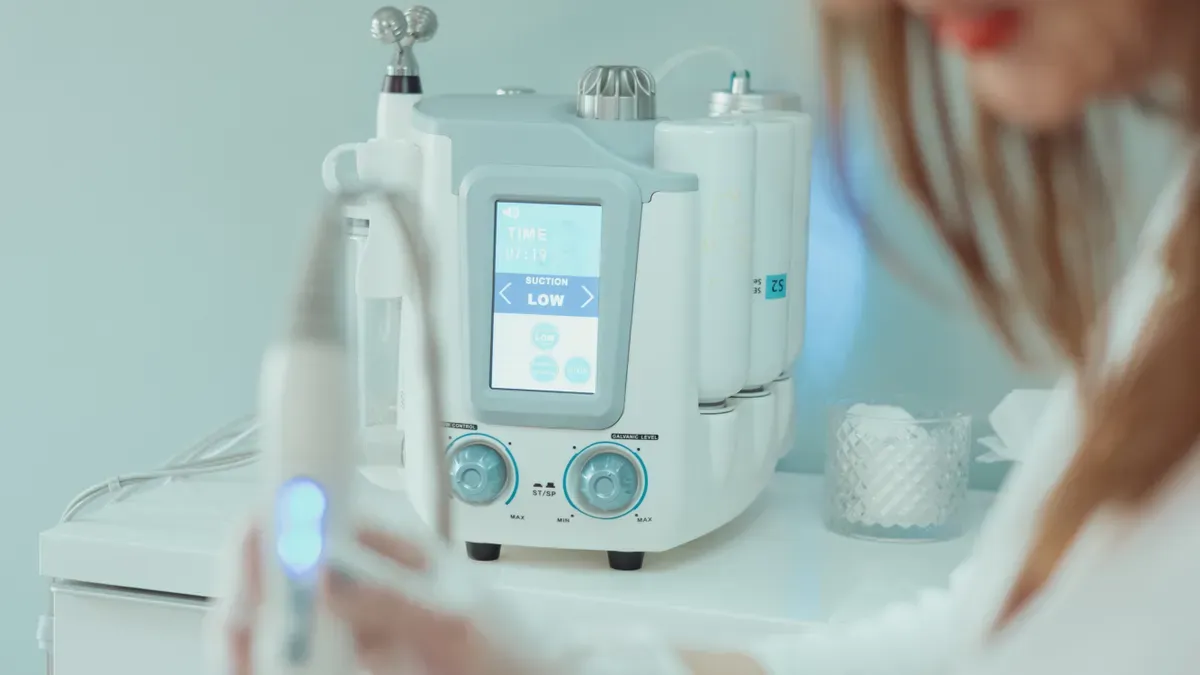
Image Source: pexels
Moving a formulation from a benchtop batch to a full production run exposes every weakness in a mechanical design. Geometric and dynamic similarity provide the framework for predicting how a process will behave at larger volumes. Geometric similarity means the ratios of vessel dimensions stay constant. Dynamic similarity means the ratios of forces—shear, gravity, and inertia—remain equivalent. Achieving both is rare in practice.
A lab mixer with a 1-liter vessel cannot simply be enlarged to 1,000 liters. The surface area to volume ratio drops sharply. Heat transfer slows. Shear forces at the impeller tip change. A process that emulsified perfectly in the lab may separate in production. Engineers must adjust impeller speed, baffle placement, and fill level to compensate. These adjustments require iterative testing.
Droplet size distribution must stay within specification across scales. A cream that feels silky at 5 liters can turn grainy at 500 liters. Inline sensors and statistical process control catch these deviations early. Batch records track every parameter against the lab reference. This traceability supports regulatory audits and protects brand reputation.
Top Lab equipment uses interchangeable vessels, mixers, and filling heads. A formulator can swap a rotor-stator for a planetary mixer in minutes. This modularity accelerates recipe development. The trade-off is lower throughput and higher per-unit labor.
Huayang filling lines scale through configurable modules. A base filling station accepts different nozzle arrays, conveyor widths, and capping units. Jaywin Machinery offers customizable solutions for each configuration. This approach lets manufacturers expand capacity without replacing the entire line.
Jaywin Machinery also offers cosmetic powder equipment for both lab-scale and production-scale powder filling and pressing. The line includes automatic powder filling machines for loose powders, eyeshadow and blush powder filling machines, and vacuum powder presses. A laboratory hydraulic powder press supports small-batch testing with adjustable pressure settings. Production models handle continuous operation with minimal waste. This range lets a manufacturer validate a powder formula on benchtop equipment and then scale to a full line using the same mechanical principles.
Capital expenditure and operational efficiency pull in opposite directions. The table below compares key factors across the lab-to-production spectrum.
Factor | Top Lab (Benchtop) | Huayang Filling (Production) |
|---|---|---|
Capital expenditure | Low | High |
Throughput | Low | High |
Labor per unit | High | Low |
Changeover time | Fast | Moderate |
Maintenance complexity | Low | High |
A benchtop system minimizes upfront cost but demands more operator time. A production line requires significant capital but reduces labor and increases output. Maintenance and downtime also scale with complexity. A single filling station failure can halt an entire line. Redundant components and predictive maintenance schedules reduce this risk. The right balance depends on production volume, product mix, and growth projections. Effective cosmetic machinery design accounts for these trade-offs before the first component is specified.
Filling systems, mixing and emulsification units, and pumping mechanisms each shape product quality and batch consistency. Filling accuracy controls dose uniformity. Mixing and emulsification determine texture and stability. Pumping mechanisms preserve formulation integrity during transfer. Material compatibility, precision, and hygiene cut across every structure. These parameters prevent contamination, reduce waste, and meet regulatory standards. Integration and control systems unify these mechanical structures. PLC and HMI architectures synchronize filling, mixing, and pumping for scalable production. The lab-to-production spectrum balances flexibility and throughput. Top Lab supports R&D with modular benchtop systems. Huayang filling delivers high-volume consistency through automation. Mechanical design innovation will continue to drive efficiency, precision, and scalability in cosmetic manufacturing.
Cosmetic machinery design centers on three mechanical pillars: filling systems, mixing and emulsification units, and pumping mechanisms. These structures control how equipment handles raw materials, maintains batch consistency, and supports production scale. Material compatibility, precision, and hygiene cut across every design decision.
A servo-driven piston pump measures each dose by positive displacement. Filling accuracy reaches ±0.1 mL. Preheating up to 140°C keeps high-viscosity material flowing. An anti-drip nozzle prevents stringing between fills.
Thin liquids flow through centrifugal pumps without issue. Thick creams and pastes require positive displacement. Shear-sensitive formulations need gentle mechanisms like lobe or peristaltic pumps. Gear pumps apply too much shear for delicate actives. Matching the pump to the product prevents quality loss.
Jacketed vessels circulate heating or cooling fluid around the mixing chamber. Temperature governs emulsifier activation, wax melting, and active incorporation. The optimal range is 20°C–90°C with ±0.5°C tolerance. Deviations cause phase separation, crystal formation, and viscosity collapse.
A PLC executes machine logic and reads sensor inputs. An HMI provides the operator screen for monitoring and adjustment. Together they store recipes, set temperatures and fill volumes automatically, and log every parameter against a batch number for traceability.
Top Lab prioritizes flexibility with modular benchtop systems and manual adjustments for R&D. Huayang filling maximizes output through servo-driven automation and closed-loop feedback. The trade-off is throughput versus per-unit labor and capital expenditure.
Cosmetic powder equipment includes automatic filling machines, vacuum presses, and a laboratory hydraulic press with adjustable pressure. A manufacturer validates a formula on benchtop equipment, then scales to a full line using the same mechanical principles. This range supports both small-batch testing and continuous production.
Product residues cause contamination between batches. Clean-In-Place systems flush residue without disassembly. Quick-release clamps let operators remove pistons, cylinders, and nozzles in minutes. Surfaces with Ra below 0.8 micron resist bacterial growth and simplify sanitization.


